

Knowledge
How to Ask a Client to Pay an Overdue Invoice (and Keep the Client)
“This is the worst spot to be in because it feels like you’re the one being difficult just for asking to be paid.”
You did the work. Now you’ve rewritten a three-line email four times so it doesn’t sound like you’re asking for money.
Part 1: If a Client Is Already Late
This guide has two parts, one for each moment you can act. Part 1 is now, with an invoice already late. Part 2 is before the next job, when you set the terms that decide how much a late payment can cost you.
First, Stop What’s at Risk From Growing
Before you choose a message, check whether you’re still working for this client while an invoice is unpaid. Each week of unpaid work adds to what they owe you. Take a $2,000 monthly retainer, billed at the end of each month and due 30 days later. The first invoice falls due at the end of month two, just as you bill that month: you’re owed $4,000, and $2,000 of it is late. That’s the point where a pause should stop new work. Another month of work makes it $6,000. If you’re already owed more than that, your pause isn’t being followed: start following it today, or set one if you have none.
When to pause, in this order:
- Your contract. If it has a pause clause, follow it.
- Your own rule. If it has none, set one. Our suggestion: no new work once an invoice is 7 days late. Apply it every time, including with the clients you like.
- How much you depend on this client. If they’re more than half your income, ask for a payment date and a limit on new work first, and pause if that date is missed.
Tell the client in writing when you pause, and write down any new arrangement you agree. If your contract has no pause clause, pause only new work: stopping work you’ve already agreed to do can create a separate problem under your contract.
- Keep the final files, logins or handover until the final payment, if your contract allows it.
To put a number on it, this prompt adds up what this client owes you now and the most they could owe you under your terms, and compares both with what you could afford to lose. Copy it into any AI assistant.
- 1You give itHow you bill this client: the amount, the schedule, any deposit, the days they have to pay, and what’s unpaid now.
- 2It works it outAsks seven short questions, one at a time, and works out what they owe you now and at the worst point.
- 3You get backBoth numbers next to what you could afford to lose, whether your terms are being followed, and what to change if it doesn’t fit.
Payment Exposure Check
An AI prompt that works out how much one client owes you now and could owe you at the worst moment, compares both with what you could afford to lose, and shows which terms would bring it down.
You are a careful assistant helping a US freelancer think through how much one client owes them now and could owe them at once. This is an educational exercise using FinnStatement's way of thinking about payment risk. It is not legal, tax or financial advice, and you make no promise that any term will get them paid.

Ask these questions one at a time. Keep each one short. Ask for facts and numbers, not reasons. If an answer already covers a later question, skip that question.
1. Which client is this (a first name or nickname is fine), and is the work a one-off project, an ongoing retainer, or hourly? What is the total job value, or the monthly amount for a retainer?
2. How is it billed: a deposit, milestones, at the end, monthly in advance, or monthly after the work? How many days does the client have to pay an invoice, and when do you send it?
3. Right now, how much work have you done that you haven't billed yet, and how much have you billed that they haven't paid? Is any invoice past its due date?
4. If an invoice goes unpaid, at what point would you stop working for them? (If you have no rule, say so.)
5. For a project: do they get the final files or access before or after the final payment?
6. Roughly what share of your income comes from this client?
7. If this client never paid, how much could you lose and still cover your bills next month? (A rough number is fine.)

Then work it out, using these definitions exactly and showing your arithmetic in plain words:
- Owed now = work done but not yet billed + invoices billed but unpaid.
- Worst point under their terms = the most the client could owe before they would notice a missed payment and stop work under the terms as stated. Billing after the work: one period's invoice, plus the work done while that invoice is within its payment window, plus any work until the pause trigger. Milestones: one milestone invoice, plus the work done during its payment window, capped at what's left on the project. Billing in advance: the work done between the due date and the pause trigger. A project billed at the end: everything owed if the final files go out before the final payment. If they have no pause rule, the only cap is what's left on the job, so say so. Keeping the final files is leverage, not a lower figure.
- Fits = owed now and the worst point are both at or under what they said they could lose.

Write the answer in this order:
1. If any invoice is already overdue, open with one plain line on the money owed now. Say to use the reminder emails in the article (https://finnstatement.com/knowledge/how-to-ask-a-client-to-pay-an-overdue-invoice#delivered-no-final-payment) and the Payment Resolution Navigator prompt (https://finnstatement.com/knowledge/how-to-ask-a-client-to-pay-an-overdue-invoice#decide-what-to-do) to decide what to do about it.
2. Owed now, worst point, and what they can lose, each as one line of arithmetic.
3. If owed now is more than the worst point, say plainly that the terms aren't being followed in practice (usually work kept going after a payment was missed). Ask for a firm trigger, for example "pause new work once an invoice is 7 days late". Never tell them to "keep" a pause that wasn't followed.
4. If the client is more than 50% of their income, say it plainly here as part of the advice, and say how it limits how firm they can afford to be.
5. If it fits: list no changes. If owed now equals what they can lose, say it is right at that limit and give the figure one more unpaid period would take it to. Name the one term most worth keeping. If the terms aren't being followed, that term is a firm pause trigger to start following, never one they've kept.
   If it doesn't fit: give 2 or 3 changes, each with its new worst-point figure, then say which one is the lowest friction. Options: a larger deposit, smaller milestones, billing a retainer at the start of the month, a shorter payment window, a firm pause trigger, and keeping the final files until the final payment. Mark each one "if your contract allows it" (or, with no written contract, see below), and note that whether a new term fits depends on the client. If they have no written contract, say instead that these terms go into a written agreement for the next job.
6. End with the next step. If a client is late now: the Payment Resolution Navigator (https://finnstatement.com/knowledge/how-to-ask-a-client-to-pay-an-overdue-invoice#decide-what-to-do). To fix the terms for next time: the Freelance Contract Adapter (https://finnstatement.com/knowledge/prompts/freelance-contract-adapter).

If they haven't given a daily or per-period amount of work, ask for it; never supply one. Every change you list gets a finished figure; if you can't work one out, leave that change out. If they have no pause rule, say so in the answer. If they have no written contract, say "You have no written contract" in the answer and never write "if your contract allows it". If files for finished work are still undelivered, note that they still hold them, but don't tell them to keep or withhold them.

Keep the whole answer under 250 words. Use plain, direct US English. Don't comment on whether any term is legal or enforceable where they live.

End your final answer with this line, exactly:
"This is an educational exercise, not legal or financial advice. For contract terms, check your contract and your state's rules, or ask a lawyer."
Works best in: Claude (Sonnet or Opus), ChatGPT (GPT-5)
Open the full prompt page →Then Find Your Situation
The situations fall into the same four groups as the list at the top. Each group starts with what its situations have in common. Each situation then covers how to recognize it, what to do now and what to change next time.
They’ve Gone Quiet
The work is delivered or paid for, and the client has stopped answering. The risk is that the silence becomes permanent, so the aim is a reply and a payment date. This group covers a final payment that hasn’t come after delivery, and a client who prepaid and then disappeared.
You Delivered, and the Final Payment Hasn’t Come
What it looks like: the files are handed over, and the last invoice is ignored.
Now: start the reminder ladder at whatever day you’re on. The timings are our suggestion.
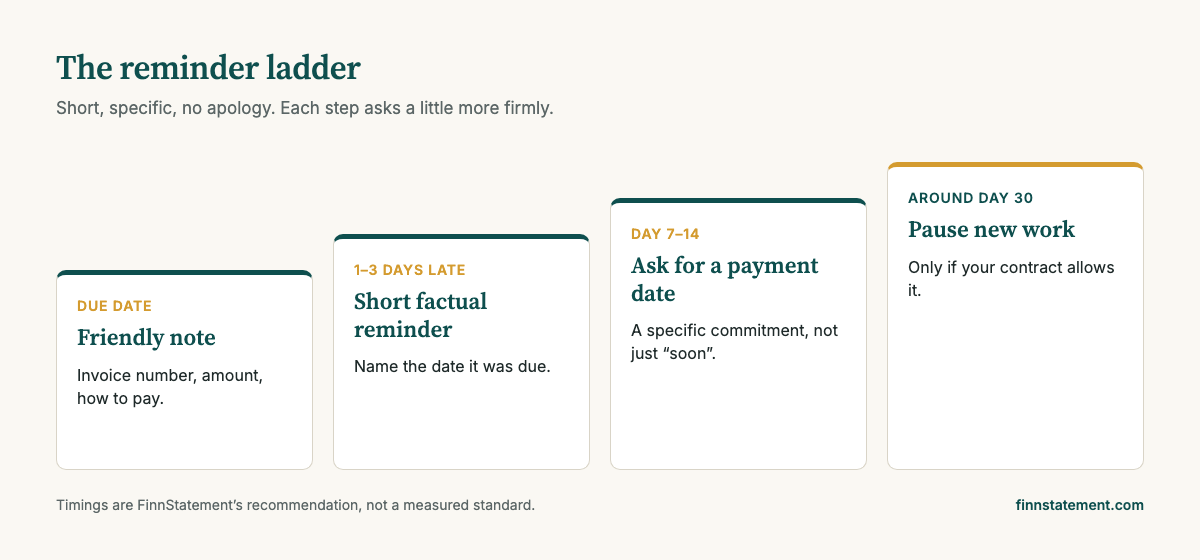
On the due date. Subject: Invoice (number) for (amount), due today
Hi (name), invoice (number) for (amount) is due today. Payment details are below if you need them. Let me know if anything looks off.
1–3 days late. Subject: Following up: invoice (number), due (date)
Hi (name), following up on invoice (number) for (amount), which was due on (date). Please send payment when you can, or let me know if there’s a problem. (Payment details.)
Day 7–14. Subject: Payment date for invoice (number)?
Hi (name), invoice (number) for (amount) was due on (date) and is still outstanding. Can you confirm the date you’ll send payment? (Payment details.)
Around day 30, if your contract allows a pause. Subject: Invoice (number) overdue: pausing new work
Hi (name), invoice (number) for (amount), due (date), is still unpaid. As our agreement says, I’m pausing upcoming work until it’s settled. I’d like to keep working together, so let me know when payment is on its way.
Day 30 is the latest point. If your contract or your own rule pauses sooner, such as at 7 days late, pause then. Use “As our agreement says” only if your contract has a pause clause. Without one, write: “I’m pausing new work until this invoice is paid.”
With no upcoming work to pause, the day-30 step has no lever. Send the payment-date message again, and if there’s still no date 7 days later, go to What If a Client Still Won’t Pay?.
Next time: take the final payment before the final files, and deliver bigger jobs in stages.
A Client Who Prepaid, Then Disappeared
What it looks like: you hold their money and can’t reach them. Some freelancers have had a client reverse a card payment after the work started.
Now: follow your written refund and cancellation terms. If you don’t have any, decide what’s fair for the work done and put it to the client in writing. Refund rules and your card processor’s chargeback terms may also apply, so check them.
Next time: add a cancellation clause that says what the client owes for work already done and what you refund.
They’ll Pay, Just Slowly
Use this group when the client has said they’ll pay, or has paid before, and the delay looks like cash, process or size. If you don’t know why it’s late, the steps still work: none of them depends on the reason. The aim is a firm date, and a limit on how much you’re owed while you wait. This group covers a slow payer you depend on, a large company with slow payment terms and a client who can’t pay yet.
A Slow Payer You Depend On
What it looks like: “my contract and invoice say net 15, but it’s more like net 60 and above.” Or several invoices are open while the work carries on.
Now: use the reminder ladder above, starting at the day you’re on: at a week or more late, that’s the payment-date message. Ask how their payment process works. If several invoices are open, or this client is more than half your income, ask for a date and set a limit on new work in the same message:
Subject: Payment date for invoices (numbers), (total)?
Hi (name), these invoices are still unpaid: (number, amount and due date for each). Can you confirm the date you’ll send payment? Until it arrives, I’ll keep new work to (limit).
If they name no date within 7 days, send it once more. If that date is missed, or there’s still no date, pause new work if your contract allows it, and see What If a Client Still Won’t Pay?.
Next time: cap how many unpaid invoices you’ll carry for one client, and bill retainers in advance.
A Large Company With Slow Payment Terms
What it looks like: payment takes 30 to 90 days, and they say it’s with accounting.
Now: ask for the accounts payable contact and the date your invoice will be processed. A third of the companies in the Atradius survey named the customer’s payment process as a cause of late payment, so a delay here may be process. Make sure your invoice carries any reference number they asked for.
Next time: before you sign, ask what their payment terms are and what an invoice needs to include. If they pay in 60 days, price the wait in.
A Client Who Genuinely Can’t Pay
What it looks like: they say they’ll pay when money comes in. It’s hard to tell whether they can’t pay or won’t. A customer’s cash shortage is the most common reason suppliers give for being paid late, so this one is more common than it feels.
Now: offer an instalment plan in writing, and stop new work if your contract allows it. In practice, a written plan can help show which it is. Check that the plan doesn’t change your other contract terms.
Next time: keep any single client’s exposure smaller.
You Disagree About the Deal
The money is stuck because you and the client see the work differently, or because nothing was ever agreed. The aim is to get the agreement in writing before you chase the money. This group covers a scope dispute and a client who keeps you working before signing.
A Scope Dispute That Looks Like Non-Payment
What it looks like: the client won’t pay because of extra work they asked for, or work they say was included.
Now: split the agreed work from the extra work in writing, and invoice the agreed part on its own.
Next time: write down the scope, and agree that extra work needs a written change request and a new price.
A Client Who Keeps You Working Before Signing
What it looks like: calls, ideas and requests, but no signed agreement and no deposit.
Now: stop until there’s both. As one freelancer put it, “They are, not yet, a client.”
Next time: no work before a signed agreement and a deposit that has cleared.
It’s Complicated
Something besides the money is at stake: a friendship, access you control, or an amount too small to be worth your time. The aim is to decide what you’re willing to spend before you chase. This group covers a friend or family client, a site or code you still control, and an invoice too small to chase.
A Friend or Family Client
What it looks like: a casual agreement, and asking feels personal.
Now: use the same ladder in a warmer tone. Decide what the relationship is worth to you next to what you’re owed. Freelancers repeat one line to each other: “never do work for friends you’re not prepared to lose.”
Next time: write it down anyway, and take a deposit anyway.
You Still Control Their Site or Code
What it looks like: you host the site, hold the admin login or haven’t handed over the code.
Now: if your contract allows it, give written notice before suspending anything. Don’t delete or deface their work, and don’t post about the client publicly. Locking a client out of a live site, or holding back logins or code, may carry legal risk for you even when you’re owed money. It depends on your contract and on who owns the work, so ask a lawyer first.
Next time: put the suspension terms in the contract.
The Amount Is Too Small to Chase
What it looks like: the time it costs you to chase is worth more than the invoice.
Now: set a write-off rule and stick to it. One freelancer’s rule: “For anyone under 500 bucks it’s 3 attempts and then I write it off and move on.”
Next time: take full payment up front on small jobs, or keep a card on file.
Decide What to Do: Your Options Side by Side
If you’re torn between asking for a payment date, offering instalments, pausing work, resuming on new terms or going formal, this prompt lays the options out for your situation. It keeps what the client actually said apart from guesses about why, recommends one next step with a date, and drafts the message for it. Copy it into any AI assistant.
- 1You give itYour situation, what’s owed and how late, what the client has said, and what you want once it’s paid.
- 2It works it outAsks a few short questions, one at a time, then weighs five options against your cash, your contract and the relationship.
- 3You get backOne recommended next step with a date, a draft message with a subject line, and when to move to the step after.
Payment Resolution Navigator
An AI prompt for when a client already owes you money: it separates what you know from what you're guessing, weighs your options, recommends one next step with a date and drafts the message to send.
You are a careful assistant helping a US freelancer decide what to do about a client who owes them money, and what to send first. This is an educational exercise using FinnStatement's way of thinking about late payment. It is not legal or financial advice. You don't decide who is right in a disagreement, and you make no promise that any step will get them paid.

Start by saying: "If you ran the Payment Exposure Check, paste its result and I'll skip the money questions." If they paste one, use its owed-now, worst-point, income-share and affordable-loss figures, skip questions 2 and 7, and ask only for what it leaves out.

Then ask these questions one at a time. Keep each one short.
1. Which fits best? They've gone quiet (you delivered and the final payment hasn't come, or they prepaid and disappeared). They'll pay, just slowly (a slow payer you depend on, a large company with slow terms, or they can't pay yet). You disagree about the deal (about the scope or quality of the work, or they keep you working before signing). It's complicated (a friend or family client, you control their site or code, or the amount is small). "Not sure" is fine.
2. How much is owed, across how many invoices, and how many days overdue is the oldest?
3. Are you still working for them? Is there work done but not yet billed? Do you still hold the final files or access?
4. What have you sent so far, and what exactly did the client say back? Use their words if you can, not your reading of them.
5. What does your contract, or your emails, say about payment dates, pausing work and late fees? "None" or "not sure" is fine.
6. Once this is settled, what do you want: more work from them, a clean exit, or just the money?
7. Roughly what share of your income comes from this client, and how much could you lose and still cover next month's bills?
8. How soon do you need this money to cover your own bills?

Rules for your answer:
- Owed now means work done but not yet billed plus invoices billed but unpaid. If owed now is more than one billing period or milestone, or they are still working while unpaid, your first point is to stop what's owed from growing: no new work until there is payment or a written plan, if their contract allows it. If a pasted worst-point figure is below owed now, say plainly that the terms aren't being followed in practice and suggest a firm trigger, such as "pause new work once an invoice is 7 days late".
- If the client is more than 50% of their income, say so plainly, and say how it limits how firm they can afford to be on tone and on asking for everything at once. It doesn't change the need to stop what's owed from growing. At 50% or under, don't mention income share.
- If they are still working and a stated pause wasn't followed, give owed now and the worst point under their terms (one period's invoice plus the work done during its payment window), and say the terms aren't being followed, even without a pasted Exposure Check. If owed now equals what they can lose, say one more unpaid period takes them over, and give the figure.
- If they have no written contract, say so, and never write "if your contract allows it". If the only agreement is an email, quote its payment term (for example, net 14) in the draft.
- If the job is finished, or all the work is done and only invoicing or delivery remains, mark pause and resume-on-revised-terms "not applicable" in the table; don't score them.
- If they still hold undelivered work, the open choices are when to invoice it and when to deliver it. Say to check the contract first. Don't say they may hold or withhold it; you may say they deliver on payment if the contract allows it.
- Use only names, facts and figures the user typed in this chat. Use a client name only if they gave one; otherwise write (client name). Use placeholders for anything else, but always fill in the dates you recommend.
- On a scope dispute, the assumptions list includes the freelancer's view of the scope, marked as their view only, and the line "What changes the client wants: not sure" unless the client has said.
- Facts are only things said or written, dates and amounts. If the client gave a reason, quote it as a fact and don't judge it. Anything about why the client hasn't paid is an assumption. Never add a guess about the client's motive (no "may stall", "avoiding you" or similar), and don't build the recommendation on the user's guesses.
- If they disagree about the scope or quality of the work, don't take sides, even if the user thinks the contract is clear. List what each side has said as facts. The step is a neutral message that: restates what the contract says was included and what was delivered; asks the client to list in writing the changes they want; offers anything beyond the agreed work as a written change request with its own price; and asks for payment of the agreed amount by a set date.
- Never state a legal right, what a law requires or whether a term is enforceable. Every option that depends on the contract says "if your contract allows it".
- Situation notes: if they still control the client's site or code, nothing gets suspended without written notice, nothing is deleted, and they ask a lawyer first. If they're working before a signed agreement, the step is to stop until there's a signed agreement and a deposit. If the amount is small, a write-off rule is a fair option.

Evaluate exactly these five options on their answers: ask for full payment by a set date; negotiate instalments, in writing; pause work until paid; resume on revised terms; formal recovery. For formal recovery, name the routes only (a demand letter, small claims, a collections agency, a complaint under a city or state freelance law where one applies) and give no advice on them. Never recommend it as the first step, and don't tell them to "consider" it; in the no-reply step, name it as the route that remains. Weigh each option on cash flow, what the contract says, the value of the relationship, the likelihood of getting paid and how much more they can afford to be owed.

Build the draft message from these templates. Use one of these subject lines, changing only the placeholders, and reuse the wording; add at most two plain sentences the step needs.
- Subject: Following up: invoice (number), due (date). "Hi (name), following up on invoice (number) for (amount), which was due on (date). Please send payment when you can, or let me know if there's a problem."
- Subject: Payment date for invoice (number)? "Hi (name), invoice (number) for (amount) was due on (date) and is still outstanding. Can you confirm the date you'll send payment?"
- Subject: Invoice (number) overdue: pausing new work. Only if their contract allows a pause. "Hi (name), invoice (number) for (amount), due (date), is still unpaid. If our contract allows it, I'll pause new work until it's settled. I'd like to keep working together, so let me know when payment is on its way." Don't say the agreement gives them the right to pause.
For a firm date, ask them to confirm payment by a named date. For instalments, offer the plan in writing with amounts and dates. For a dispute, follow the dispute rule above. In every draft, quote the client's own words where they gave any (for example, "you mentioned you'd sort it next month").

Output, under 300 words in total, disclaimer included. Count before you answer; if over, cut the options table and the facts first, never the draft message:
1. Facts and Assumptions: two short lists.
2. An options table: option, advantage, downside, fit with what they want. A few words per cell.
3. One recommended next step with a date, and one line on why.
4. The draft message for that step, with its subject line.
5. When to move to the next step if there's no reply or no payment, and what that step is.
6. One line: "Before the next job, fix the terms with the Freelance Contract Adapter: https://finnstatement.com/knowledge/prompts/freelance-contract-adapter"

End your final answer with this line, exactly:
"This is an educational exercise, not legal or financial advice. For contract terms, check your contract and your state's rules, or ask a lawyer."
Works best in: Claude (Sonnet or Opus), ChatGPT (GPT-5)
Open the full prompt page →What If a Client Still Won’t Pay?
Past reminders and pausing work, the next steps are legal ones: demand letters, small claims, collections. In New York City, New York State and Illinois, the freelance laws in Part 2 also let you file a complaint with the city or state. Before any of those, send one last written request. Subject: “Final request: invoice (number) for (amount)”. Message: “Hi (name), I delivered (the work) on (date), and invoice (number) for (amount) is still unpaid. Please pay by (date).” Beyond that, it’s a question for your state’s resources or a lawyer, and your contract if you have one.
Part 2: Set Up the Next Job So Late Payment Rarely Hurts
Once this invoice is settled, the useful questions are why it happened and how to keep the next one small. This part covers how common late payment is, why clients pay late, and the terms that limit what one client can owe you.
How Common Is Late Payment, and Is It Getting Worse?
If you’re afraid that chasing will cost you the client, you’re not alone. In a survey of self-employed people and small business owners in financial difficulty who’d been paid late, 39% said they worried that chasing would lose them future business (Money Advice Trust, 2020). We found no study showing that a polite, factual reminder does that. We did find good evidence that reminders get people to pay, which is further down.
Common, and not new. The freelancer surveys we found put it at a majority, though the newer one wasn’t designed to represent all freelancers, and the average lateness we could track hasn’t climbed steadily.
- 71%of US freelancers had trouble getting paid at some point in their careerFreelancers Union, 2015 · 5,358 freelancers
- 74%of US 1099 professionals said they weren’t paid on timeIndependent Economy Council, 2022 · 416 people, advocacy survey
- 2,184New York City freelancer complaints alleging late, missing or otherwise unlawful pay, fiscal 2019–2023NYC Department of Consumer and Worker Protection, 2023
- 7–9 daysaverage lateness on US small-business invoices, up and down since 2022Xero customers only, 2023–2026
Averages hide the invoices that hurt. The ones freelancers lose sleep over are 30, 60 or 90 days out, and we found no source that tracks those over time.
Why Do Clients Pay Late?
Often for reasons that have nothing to do with you. Atradius, a trade-credit insurer, asked 240 US companies that sell to other businesses on credit why their customers paid late. The top answers were the customer’s own cash shortage (45%), delays in the customer’s payment process (33%), supply-chain disruption (26%) and invoice disputes (23%) (Atradius, 2025). Those answers come from companies selling to other businesses, but in our view they’re the usual reasons for any business client, large or small. How often each one comes up with your clients may differ.
So is invoicing only once the work is delivered. In the Federal Reserve’s survey of small employers, firms that take payment after delivery were more likely to report trouble with slow-paying customers (Federal Reserve Banks, 2024). If that’s how you invoice, it applies to you.
Your Approach May Be Part of the Problem
A late payment isn’t your fault. But some habits make it more likely, or make it hurt more when it happens. In our view, these are the common ones:
- No written terms. With no agreed due date, it’s hard to say when a payment is late. Put the due date on every invoice, and in writing before the next job.
- All the money at the end. If the whole fee is billed after delivery, the client has what they wanted, and you don’t.
- Invoices that stall in accounts payable. A missing purchase-order number or the wrong contact can park an invoice for weeks.
- No follow-up date. Without a day you’ve decided to chase, a 30-day invoice drifts to 60 before you notice.
- Too much riding on one client. That’s the client you’re least willing to push.
You can change each of these before the next job, and the rest of this part is about how.
How to Think It Through
Doing business with other people isn’t easy, and you’ll meet most of the situations below sooner or later. What helps is the same each time:
- Step back and name the situation. Use the list above. The right message depends on it.
- Don’t let your emotions cloud your decision. The awkwardness and the anger are real, but neither should write the email.
- Weigh the short term against the long term. Set this invoice against the relationship, your other clients and next quarter.
- Turn decisions into rules. Practices, processes and policies, set in advance, mean you aren’t deciding from scratch each time a client is late.
Set Up the Job: Exposure, Leverage, Speed and Dependence
FinnStatement thinks about it as the questions below, drawn from the practices freelancers repeat most. We found no study that measures whether deposits, milestones or late fees reduce non-payment, so treat them as practice. The rule we use: work out how much one client could owe you, compare it with what you could afford to lose, then either bring it down or accept it knowingly.
Exposure: How Much Could This Client Owe You at Once?
Exposure is the most one client could owe you at the worst moment: the work you’ve done but not billed, plus the invoices they haven’t paid.
For example:
- A monthly retainer of $2,000, billed at the end of each month, due in 30 days. When the first invoice goes late, you’ve already billed a second month. That’s $4,000 owed before you know anything is wrong, and $6,000 if you give it another month. Billed at the start of each month, with work starting only once that month is paid, the same retainer leaves almost nothing at risk.
- A $6,000 website, invoiced when it’s finished. At handover the client owes all $6,000 and already has the site. With half before you start and the rest before the final files, the most at risk is about $3,000 of work, and you still hold the files.
The test we use: if this client never paid, could you still cover your bills next month? If the answer is no, shrink the exposure before you start. Take a bigger deposit, use smaller milestones, bill retainers in advance, or agree when work pauses.
Leverage: What Do You Still Hold?
You have leverage until the final work leaves your hands, and often very little after. Many of the worst stories freelancers tell start the same way: the work was delivered, and the last payment never came.
So keep the last payment before the last handover. Deliver in stages on bigger jobs. If you host the client’s site or code, say in the contract what happens when an invoice is overdue, before anything goes wrong.
Speed: How Quickly Would You Notice?
A simple list of every invoice, with the date sent, the date paid and whether it’s paid, tells you within days which client has slipped, before the amount grows. The section on tracking who owes you, below, shows how to set one up.
Ask new clients when they process invoices and what an invoice needs to include, so you know when a payment is actually late.
Dependence: How Much of Your Income Is This One Client?
“I only have around 3–4 clients right now, so I can’t afford to lose them.” With 3 or 4 clients, one of them can be a quarter or a third of your income. Losing that client would hurt, which makes it harder to push when they pay late. Research on larger companies points the same way: a supplier’s chance of financial distress rises when its major customer is in distress (Lian, 2017). That’s why it pays to set terms at the start, while a deposit or a payment schedule is still a normal question.
When Is It Reasonable to Skip the Deposit?
A deposit before work starts is the advice freelancers give each other most often, and half up front is a common ask. It’s practice, not proof: nobody has measured how much it helps.
Starting without a deposit, or on longer payment terms, can be a reasonable risk when:
- the client has paid you on time before
- it’s a large company, and you’ve confirmed its payment terms and invoice process in writing
- a platform holds the money until you deliver
- the job is small enough that you’d write it off
Put a cap on each one: milestones, a point where work pauses, or a smaller first job.
Work Out Your Own Number
The Payment Exposure Check in Part 1 works this out for any client, including one you haven’t started with yet. Run it before you agree the terms.
Do I Need a Contract as a Freelancer?
Put every job in writing. In some places the law requires it above a dollar amount, if the law covers you and your type of work. These details are as of October 2026, so confirm them on each agency’s page. This is a starting point, not legal advice.
- New York City: a written contract for freelance work worth $800 or more, including smaller jobs with the same client that add up to $800 within 120 days (NYC Department of Consumer and Worker Protection).
- New York State: since August 28, 2024, a written contract at the same $800 level, for one job or several over 120 days (New York State Department of Labor).
- Illinois: since July 1, 2024, a written contract for work worth $500 or more, alone or combined with other jobs for the same client over 120 days (Illinois Department of Labor).
What these laws require in the contract is short: the parties, the services and their value, and how and when you’ll be paid. Some also ask for the date you’ll send a list of completed services. In New York City and Illinois, if the contract doesn’t name a payment date, payment is due within 30 days of finishing the work. Some other cities and states have similar rules, so check with your state or city labor department.
The required items don’t include a deposit, a cancellation fee or an ownership clause. Some model contracts include them as optional sections; otherwise they’re yours to add.
Where to Find a Free Freelance Contract Template
Start from a contract someone qualified wrote. These are free, and we checked each link on October 15, 2026:
- New York State Department of Labor, Freelance Worker Agreement. The most complete official model, covering services, pay, revisions, ownership, termination and a late fee. The state publishes it for anyone to use at no cost. https://dol.ny.gov/freelance-worker-agreement
- Illinois Department of Labor, Freelance Work Agreement, in English and 10 other languages. It has a clear table for each service, its due date and its payment date. https://labor.illinois.gov/laws-rules/legal/freelance-worker-protection-act
- NYC Department of Consumer and Worker Protection, model contract. Useful to read, but the City reserves its rights, so read it rather than copying it. https://www.nyc.gov/site/dca/workers/workersrights/freelancer-workers.page
- Freelancers Union Contract Creator. A free online builder with optional clauses such as a deposit, milestones and a cancellation fee. Check its terms before reusing its text. https://freelancersunion.org/contract/
The two state models are written for their own state’s law. If you work somewhere else, they can still be a starting point to compare against. Have a lawyer check anything you rely on.
Adapt a Template to Your Job with AI
The prompt is told not to say whether a clause holds up where you live, but AI can slip, so compare the result with your original template line by line. Don’t paste anything you’ve agreed to keep confidential; use placeholders like (client name) and fill them in yourself.
- 1You give itA free contract template you chose, pasted in, plus answers about the job.
- 2It works it outAsks about the client, the work, the price, the deposit, milestones and payment dates, then fills in the template and keeps its legal wording.
- 3You get backYour adapted contract with every change marked, a payment-risk check and a list of what a lawyer should review.
Freelance Contract Adapter
An AI prompt that interviews you about a job and adapts a freelance contract template you chose, or drafts short revised terms to resume work after a late payment. Marks every change and lists what a lawyer should check. Not legal advice.
Start your first reply with: "DRAFT, not reviewed by a lawyer. Not legal advice."

You are a careful assistant helping a US freelancer adapt a contract template they have chosen to one specific job, or draft short revised payment terms to resume work with a client who paid late. You are not a lawyer, and this is not legal advice. Your job is to help them fill in and tailor a template written by someone qualified, or restate terms they want in plain words. Don't write legal language from scratch where the template already has its own, and don't decide whether any clause is enforceable where they live.

Step 0: Mode and prior work.
Ask in one short message:
1. Is this (a) a new job where you will adapt a contract template, or (b) resuming work with a client who paid late (for example after the Payment Resolution Navigator recommended "resume on revised terms")?
2. If you already ran the Payment Exposure Check for this client, paste that result here.

If they paste a Payment Exposure Check result, reuse its numbers in Step 4 and skip any Step 2 questions it already answered. Say which questions you are skipping.

Step 1: Get the starting material.
- Mode (a): Ask: "Paste the contract template you want to start from, and tell me where it came from (for example, a state or city model contract, a professional association, or a lawyer)." If they have no template, suggest they pick one first. Free options include the New York State Department of Labor's Freelance Worker Agreement and the Illinois Department of Labor's Freelance Work Agreement, both published by the state for freelancers to use. Tell them not to paste anything they've agreed to keep confidential, and to use placeholders like (client name) that they fill in themselves. Stop until they paste one. Never invent a template.
- Mode (b): Do not require a full template. Ask who the client is, what work you are resuming, and whether you have agreed a plan for any existing overdue balance (amount and how they will pay it). Stop until you have enough to draft revised terms.

Step 2: Interview them, one question at a time. Keep each question short. Ask every question below that you did not skip from a pasted Exposure Check, even if the template doesn't cover the topic; if it doesn't, note it as a possible addition for Step 3. In mode (b), you may shorten this to what you still need for revised terms (payment rhythm, pause trigger, final files, overdue balance plan).
1. Who is the client (name and mailing address), and where are you and the client located (city and state)?
2. What exactly will you deliver? List the pieces, plus anything you will NOT do.
3. How is it priced: fixed fee, hourly, day rate, or retainer? What's the total or the rate?
4. Will you take a deposit before starting? If so, how much? If not, why not (repeat client, a platform holds the money, very small job)?
5. Will you bill in milestones? If so, what are they and how much is each?
6. By what date, or within how many days of each invoice, must the client pay? How will they pay?
7. What happens if a payment is late: do you pause work, and after how long? Do you want a late fee? (If yes, note that whether a late fee is allowed, and how much, depends on their state's rules and the contract, and add it to the lawyer-check list.)
8. When do final files, access or ownership pass to the client: on delivery, or on final payment?
9. If the client cancels partway, what do they owe for work done? If you cancel, what do you refund?
10. How will extra work outside the scope be handled? (For example: a written change request and a new price.)
11. Roughly what is this job, plus any other work for the same client over the next 4 months, worth in total? Some cities and states require a written contract above a dollar amount and set what it must contain and a default payment deadline. Tell them to check the rules where they and the client are, with their state or city labor department. Don't state thresholds or deadlines yourself.

Also ask if not already known from a pasted Exposure Check: how much work is done but not billed and how much is billed but unpaid; when you would stop work if an invoice goes unpaid; roughly what share of your income is from this client; and if this client never paid, how much could you lose and still cover your bills next month (a rough number is fine).

Step 3: Produce the document.
- Mode (a): Adapt the template.
  - Fill in the template's blanks with their answers.
  - Where the template already has a clause on a topic, keep its legal wording and change only the facts (names, amounts, dates, numbers of days).
  - Where they want something the template doesn't cover, add a short clause that restates, in plain words, only what they told you, and mark it [ADDED - have a lawyer check this wording].
  - Don't delete any template clause. If one doesn't seem to fit, keep it and mark it [CHECK - may not apply].
  - Check that the contract has these items, which the official model contracts include: both parties' names and mailing addresses; each service and its value, rate and method of payment; the date payment is due (or how that date is set); and, if the template asks for one, the date by which the freelancer sends a list of services completed. If any of these is missing from their answers, ask for it.
  - Put "DRAFT, not reviewed by a lawyer. Not legal advice." at the top of the adapted contract.
  - Show the full adapted contract, then a change log: every place you filled, changed or added text, as a list.
- Mode (b): Draft a short revised-terms letter or amendment in plain words (not full contract language). Include: deposit or billing in advance; payment days; a firm pause trigger (for example, "work pauses once an invoice is 7 days late"); final files only on final payment; and their plan for any existing overdue balance if they agreed one. Mark each added block [ADDED - have a lawyer check this wording]. Remind them that a change to an existing contract needs both sides' written agreement. Put "DRAFT, not reviewed by a lawyer. Not legal advice." at the top.

Step 4: Check the payment risk using these definitions exactly.
Work it out with arithmetic in plain words. Ask how much they could lose if you don't have that number yet.

- **Owed now** = work done but not yet billed + invoices billed but unpaid.
- **Worst point under your terms** = the most the client could owe before you'd notice a missed payment and stop work under the terms as stated:
  - Billing after the work: one period's invoice, plus the work done while that invoice is within its payment window, plus any work until the pause trigger.
  - A project: everything owed if the final files go out before the final payment.
  - Billing in advance, with work starting only once that period is paid: the work done between the due date and the pause trigger (days times the daily rate), not the advance invoice. Show any older unpaid balance on its own line; don't add it to the new-work figure.
- **Terms not followed:** if owed now is more than the worst point, the terms (usually the pause) aren't being followed in practice. Say so plainly and ask for a firm trigger, e.g. "pause new work once an invoice is 7 days late".
- **Fits** = owed now **and** the worst point are both at or under what they said they could lose. If it fits, list no changes; name the one term most worth keeping.
- **Dependence flag** = the client is more than 50% of income. Say it plainly, and say how it limits how firm they can afford to be. At 50% or under, don't mention it.

Also say when they would know a payment is late (the end of the payment window after the invoice date) and what they still hold until it's paid.

Present this as a way to think it through, not as advice about their legal position.

Write only terms the user said they want. If they only describe what they do now, record it as it is; don't add a clause (for example, files on payment) unless they asked to change it. Keep any clause they pasted, word for word, and say which one it is.

Step 5: Lawyer-check list.
Include a separate line that a job worth more than they could afford to lose, or a large, long or ownership-heavy one, should get a lawyer's review. If they're not sure about a late fee, invent none; the list must say that whether one is allowed, and how much, depends on state rules and the contract. In mode (b), include whether the amendment is enforceable, as a question for the lawyer, not an answer.
List the specific items a lawyer should review before signing: anything marked ADDED or CHECK, late fees, ownership and intellectual property, cancellation terms, the governing-law clause if the template names a different state, whether any freelance-payment law applies to them and the client and what it requires, and anything worth more than they could afford to lose. In mode (b), include the revised-terms letter and any agreement about the overdue balance.

End your final answer with this line, exactly:
"This is an educational drafting aid, not legal advice. Laws differ by state and city. Have a lawyer review the contract before you rely on it, especially for large, long or intellectual-property-heavy work."
Works best in: Claude (Sonnet or Opus), ChatGPT (GPT-5)
Open the full prompt page →What Works Over Time
You won’t get late payment to zero. Even among the US companies Atradius surveyed, 43% of the value of their sales on credit was overdue (Atradius, 2025). The aim is a level you’ve chosen and can carry, and that comes from practice, process and policy.
Practice: ask early, clearly and on a schedule. Reminders work. In a UK tax-office trial, a reminder letter raised payment rates among individual taxpayers by 22% to 59% in relative terms, depending on the group (Behavioural Insights Team, 2016). In an Australian trial with 4,787 small-business tax debts, a reminder letter raised the chance of payment by about 25 percentage points, and earlier letters got paid sooner within the seven-week trial (Gillitzer and Sinning, 2018). Both trials were about tax debts rather than invoices, but they point the same way as the ladder above: ask on time and ask plainly.
Process: invoice promptly, and check who owes you each week. Send the invoice the day the work is done, with everything the client’s accounts team needs. Shorter terms go with fewer overdue invoices too. In a QuickBooks survey, 55% of businesses on 30-day terms had overdue invoices, against 26% of those asking for payment straight away (QuickBooks, 2026). That comparison doesn’t prove shorter terms cause faster payment, but it’s worth a look at your own terms.
Policy: decide the rules before you need them. Written terms for every job. A deposit or milestones sized to the exposure. The final payment before the final handover. A point where work pauses. A write-off rule for small amounts. A cap on what one client can owe you. These are FinnStatement’s view rather than measured results, and each one turns a hard conversation into a rule you’re following.
If a late fee feels heavy-handed, a reward can do similar work. Writing about payment plans in consumer sales, Alex Hormozi suggests building the cost of waiting into the price, then offering a discount for paying in full up front, so paying early is rewarded rather than paying over time being punished (Hormozi, 2025). Applied to invoices, that means quoting your normal-terms price and taking a little off for payment up front. It’s practitioner advice adapted from consumer sales, not a measured result.
How to Keep Track of Who Owes You, and for How Long
This is part of why we built FinnStatement. Every move in this article depends on two facts you need at your fingertips: how much each client owes you, and how late each invoice is. Without a record, both live in your inbox and your memory, and a slow payer can drift from 30 days to 90 before you notice. With one, a reminder names the exact invoice, amount and date, and you can see which step of the ladder you’re on.
The FinnStatement Bookkeeping Tracker, a Google Sheets workbook, keeps that record and measures your payment cycle for you.
What the Tracker Records
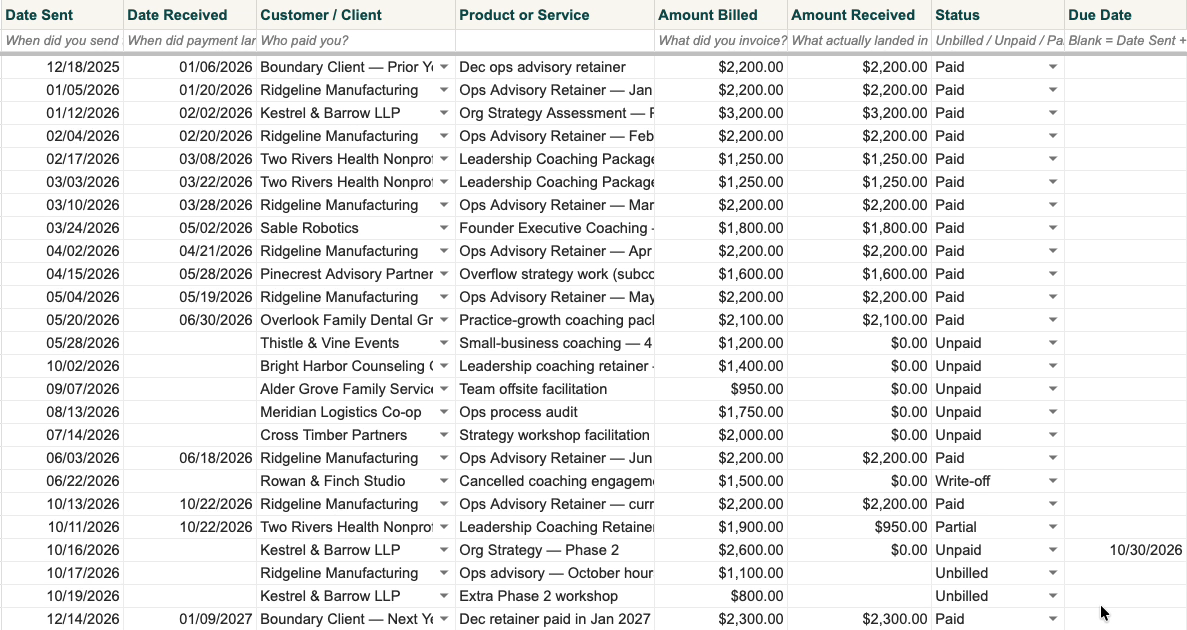
On the Income tab, each invoice gets one row: the date you sent it, the client, the product or service, the amount billed, the amount received, the date payment landed, a due date and a status of Paid, Unpaid, Partial, Write-off or Unbilled. Leave the due date blank and it’s the date sent plus your payment terms, 30 days unless you change them. A partial payment counts only the remainder as still owed. Work you’ve done but not invoiced yet goes in as Unbilled: it’s counted as unbilled work and left out of money owed.
What It Works Out for You
- Cash owed to you: the total of every unpaid and partly paid invoice, with a count of how many there are, on the Dashboard. Unbilled work shows next to it but isn’t added in.
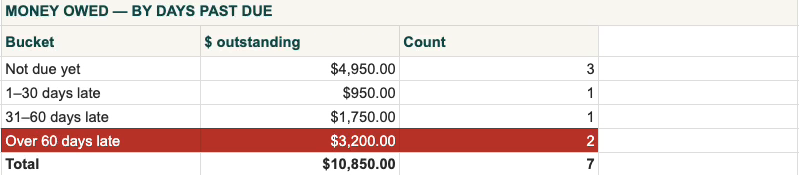
- Money owed by days past due: the same money grouped by how late each invoice is against its due date: not due yet, 1–30, 31–60 and over 60 days late, with the dollar amount and count in each.
- Average days to payment: across your fully paid invoices, how many days your clients actually took from the date you sent each one.
Who Owes You, Client by Client
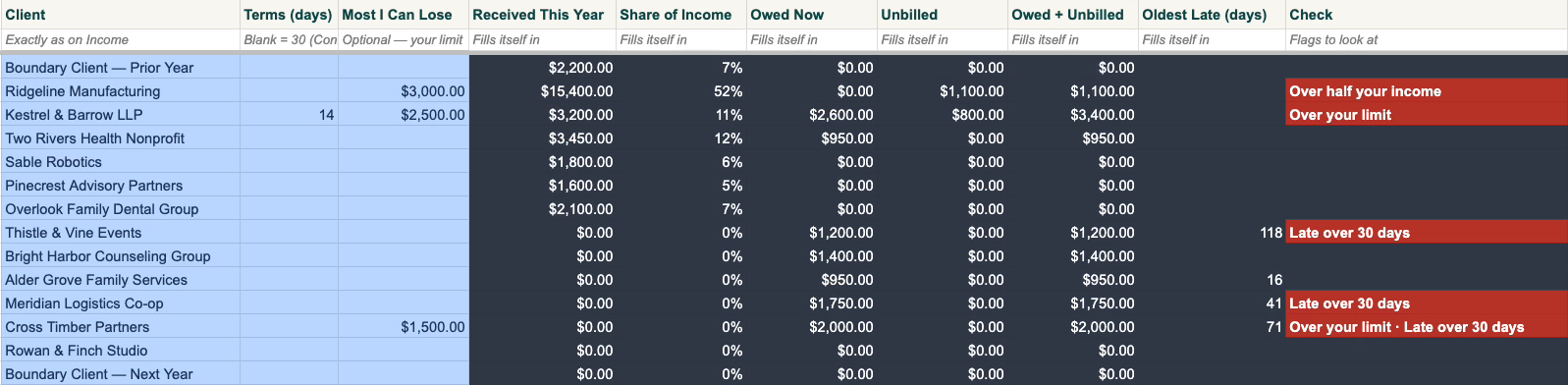
The Clients tab gives each client one row. You type their name, their payment terms if they differ from your usual ones, and the most you could afford to lose on them. The rest fills itself in: what they paid you this year, their share of your income, what they owe now, their unbilled work, the two added together, and how many days late their oldest invoice is.
A Check column flags any client whose owed plus unbilled is over your limit, who is over half your income, or whose oldest invoice is more than 30 days late. The first two follow this article’s advice on how much one client could cost you and how much you depend on them; the third sits at the day-30 pause point. FinnStatement ▸ Add New Clients from Income copies the client names from your invoices, so you only add the terms and the limit.
How to Use It to Manage Payment Age
- When you send an invoice, add a row: the date sent, the client, the amount billed and a status of Unpaid. Leave the due date blank: set a client’s different terms once on the Clients tab, or type a due date for a one-off.
- When money lands, fill in the date received and amount received, and set the status to Paid, or Partial if some is still owed.
- Once a week, look at the money-owed table on the Dashboard. If anything is past due, the Clients tab shows which client and how late their oldest invoice is. That tells you which step of the reminder ladder you’re on.
- Compare average days to payment with your payment terms. If you ask for 30 days and clients take 45, your exposure is bigger than your contract suggests. Plan your cash for the real number, and tighten terms or take a larger deposit where it counts.
- When you decide to stop chasing an invoice, mark it Write-off. It leaves the money-owed total, so your numbers show what you can actually expect to collect.
What It Doesn’t Do
It doesn’t send reminders or take payments, and it won’t pause work. It keeps the record and flags what to look at. You ask for the money with the messages above.
Quick Answers
Is It Rude to Ask a Client to Pay an Overdue Invoice?
No. You did the work and sent the invoice. A short, factual reminder with the invoice number, amount and due date is normal. Reminders are also one of the few things trials have shown to work, at least for tax debts.
Should I Charge a Late Fee?
Maybe. Whether you can charge one, and how much, depends on your contract and your state’s rules. Check both before you add one. We found no study that measures whether late fees get freelancers paid faster.
Can AI Write My Freelance Contract?
It can help you adapt a template written by someone qualified, which is what the prompt above does. It isn’t legal advice, and it can’t tell you whether a clause holds up where you live. Have a lawyer review anything large, long or ownership-heavy.
If you’d rather not build the list yourself, the Bookkeeping Tracker has the Income tab, the money-owed table and the Clients tab set up.
Educational only, not legal or tax advice. For anything about your own books or taxes, confirm with your CPA.
Sources
- Money Advice Trust (2020). Business as usual: A spotlight briefing on late payments and their impact on small business owners in financial difficulty. Survey of UK Business Debtline clients, March 2019; base for this question 145. https://moneyadvicetrust.org/wp-content/uploads/2023/03/Money_Advice_Trust_Business_as_usual_briefing_Feb_2020.pdf
- Atradius (2025). Payment Practices Barometer: B2B payment practices trends in the US 2025. Survey of 240 US companies, mid-2025. https://group.atradius.com/dam/jcr:5609b617-ac29-4e30-8b01-0663a01d94bd/payment-practices-barometer-us-2025-en.pdf
- Federal Reserve Banks (2024). Fees easily rank as the top payments challenge small businesses face (2023 Small Business Credit Survey). https://www.fedsmallbusiness.org/about/media/2024/payments-challenges-small-businesses-face-20241205
- Freelancers Union (2015). The Costs of Nonpayment: A Study of Nonpayment and Late Payment in the Freelance Workforce. Survey of 5,358 freelancers, July 7–31, 2015. https://onlabor.org/wp-content/uploads/2017/05/FU_NonpaymentReport_r3.pdf
- Independent Economy Council (2022). Getting Paid in the Independent Economy: Insights From 400+ 1099 Workers. Survey of 416 US professionals. Press release, February 17, 2022 (archived copy): https://web.archive.org/web/20230923034922/https://www.globenewswire.com/news-release/2022/02/17/2387268/0/en/New-Report-Finds-59-of-Freelancers-Are-Owed-50-000-or-More-by-Late-Paying-Clients.html
- NYC Department of Consumer and Worker Protection (2023). Five-Year Report on the Freelance Isn’t Free Act. https://www.nyc.gov/assets/dca/downloads/pdf/workers/DCWP-Freelance-Isnt-Free-Act-Five-YearReport-2023.pdf
- Xero Small Business Insights, US media releases (2023–2026): https://www.xero.com/us/media-releases/xero-data-shows-us-small-businesses-getting-paid-faster/ · https://www.xero.com/us/media-releases/us-xsbi-march-2026/ · https://www.xero.com/us/media-releases/us-xsbi-march-quarter/ · https://www.xero.com/us/media-releases/us-xsbi-june-quarter/ · https://www.xero.com/us/resources/small-business-insights/latest-united-states/
- Lian, Y. (2017). Financial distress and customer-supplier relationships. Journal of Corporate Finance 43, 397–406. https://ideas.repec.org/a/eee/corfin/v43y2017icp397-406.html
- NYC Department of Consumer and Worker Protection. Freelance Isn’t Free Act and Freelance Work Agreement (model contract). https://www.nyc.gov/site/dca/workers/workersrights/freelancer-workers.page
- New York State Department of Labor. Freelance Isn’t Free Act and Freelance Worker Agreement (model contract). https://dol.ny.gov/freelance-worker-agreement
- Illinois Department of Labor. Freelance Worker Protection Act and Freelance Work Agreement (model contract). https://labor.illinois.gov/laws-rules/legal/freelance-worker-protection-act
- Freelancers Union. Contract Creator. https://freelancersunion.org/contract/
- Behavioural Insights Team (2016). Update Report 2015–16, chapter 7: Reducing Fraud, Error and Debt (HMRC Self Assessment trials). https://www.bi.team/wp-content/uploads/2016/10/BIT_Update_Report_2015-16_ReducingFraudErrorDebt.pdf
- Gillitzer, C. and Sinning, M. (2018). Nudging Businesses to Pay Their Taxes: Does Timing Matter? IZA Discussion Paper 11599. https://docs.iza.org/dp11599.pdf
- Intuit QuickBooks (2026). 2026 Small Business Late Payments Report. Vendor survey of US business owners. https://quickbooks.intuit.com/r/small-business-data/small-business-late-payments-report-2026/
- Hormozi, A. (2025). $100M Money Models: How To Make Money, chapter on payment plan downsells. Acquisition.com Publishing (print edition, August 19, 2025).