

Knowledge
Forgot to Track Your Mileage? What You Can Still Prove, and What to Record From Today
"I kept records for everything except my vehicle expenses, gas receipts and mileage." Someone wrote that in a video comment. Everything else was in order, and the car was the gap.
If you didn't track some mileage, you can't fill the gap with an estimate. The Internal Revenue Service (IRS) says in Publication 463 (Pub 463) that you can't deduct amounts you approximate or estimate. What you can still prove depends on the evidence you have. A log you start today gives the rest of the year the record Pub 463 asks for.
Nobody told you this: for your car, the IRS doesn't accept estimates. You can't deduct amounts you approximate or estimate, and reconstructing your records is for when you can't produce a receipt because of reasons beyond your control, such as fire, flood or other casualties (IRS Pub 463 (2025), ch. 5, pp. 35–36).
Federal rules only. For your state's rules, ask your certified public accountant (CPA).
I forgot to track my mileage. What can I still prove?
That depends on the records you still have. Pub 463 has three rules that matter when your records have gaps, and one that's easy to misread (IRS Pub 463 (2025), ch. 5, p. 36):
- A specific statement plus supporting evidence. If you don't have complete records to prove an element, you must prove it with your own written or oral statement containing specific information about the element, plus other supporting evidence that is sufficient to establish it. For the cost, time, place or date of an expense, that supporting evidence must be direct evidence (written statements or the testimony of witnesses, setting out detailed information) or documentary evidence (such as receipts or paid bills). For the business purpose, it can be circumstantial: the nature of your work, such as making deliveries, is circumstantial evidence that you used the car for business.
- A representative sample. You can keep an adequate record for part of the year and use it to prove business use for the whole year, but only if you show by other evidence that those periods are representative of your use throughout the year. Pub 463's example: records kept during the first week of each month show 75% business use, and invoices and bills show business use continues at the same rate in the later weeks.
- A purpose that's clear from the circumstances. If the business purpose of a trip is clear from the surrounding circumstances, you don't need a written explanation of it. Pub 463's example is an established sales route: record the route's length once, the date of each trip at or near the time, and the total miles for the year.
- Reconstruction is a separate rule. Pub 463 lets you prove a deduction by reconstructing your records when you can't produce a receipt "because of reasons beyond your control," and it names fire, flood and other casualties. If you simply don't have complete records for some months, the rule Pub 463 gives for that gap is rule 1 above: your own specific statement plus other supporting evidence.
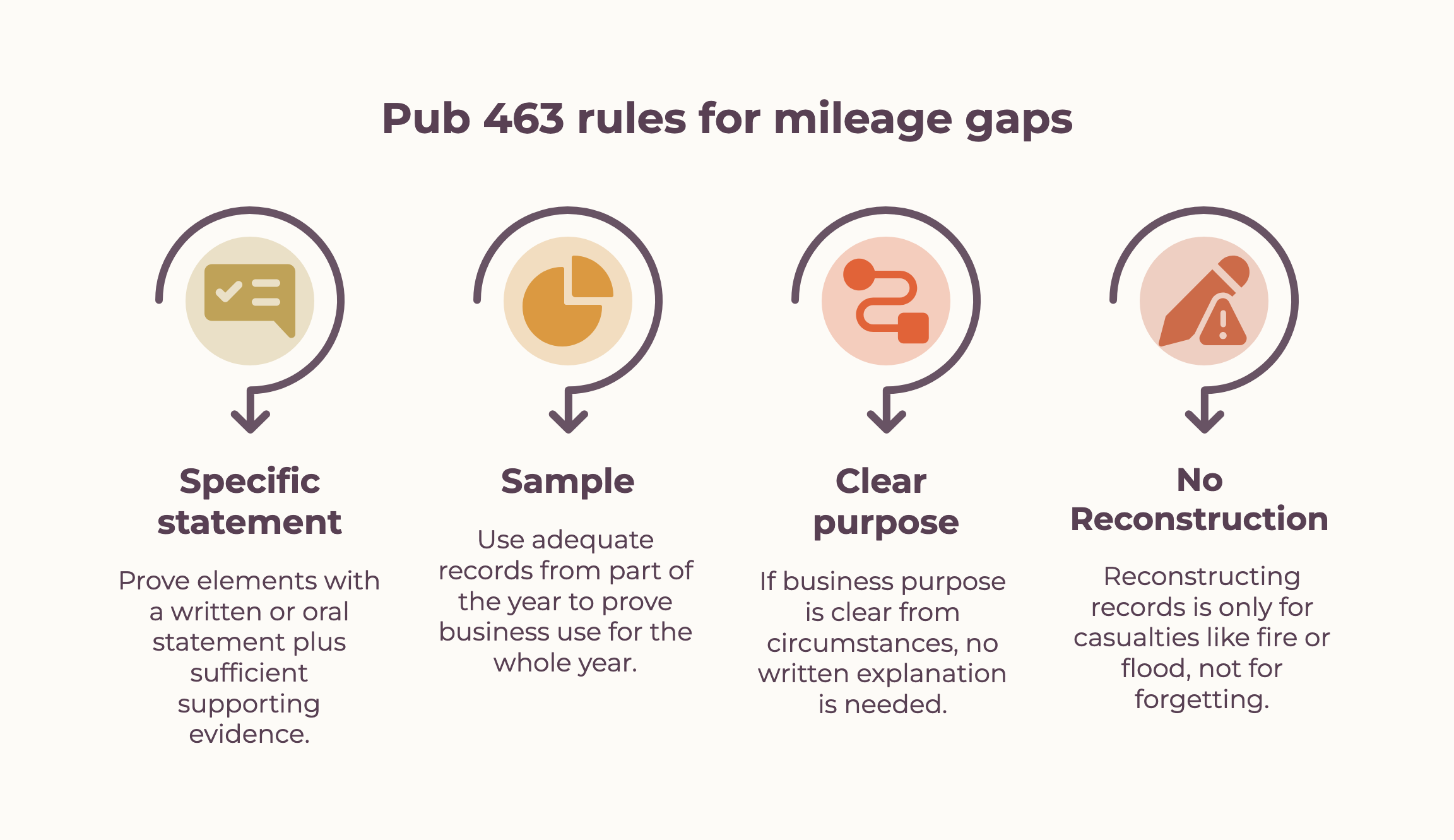
Treat the first three as conditions to check against the records and papers you have now.
If you've never recorded a trip, there may be little to check your gap months against. Start the log today.
If your gaps are large, this is a conversation for your CPA.
Can I just estimate the miles I missed?
No. Pub 463 says you can't deduct amounts you approximate or estimate (IRS Pub 463 (2025), ch. 5, p. 35).
It also says why it prefers a record made at the time: "A timely kept record has more value than a statement prepared later when there is generally a lack of accurate recall." (IRS Pub 463 (2025), ch. 5, p. 36)
That doesn't make every unlogged month worthless. Judge each month by the records you have for it.
What should I start recording today?
A record of each business trip, made at or near the time. For car expenses, Pub 463's Table 5-1 lists what the record shows (IRS Pub 463 (2025), ch. 5, Table 5-1, p. 37):
- The date you used the car
- Your business destination
- The mileage for each business use
- The business purpose of the trip
- The total miles for the year
Date, destination, mileage and business purpose go on every trip. Total miles is a single figure for the whole year. A row can be as short as: Oct 8 · client site, 400 Elm St · 14 miles · kickoff meeting with a new client.
Table 5-1 also lists the cost of the car and any improvements, and the date you started using it for business. These are one-time entries, not per-trip ones.
If you use the standard mileage rate, this log made at or near the time of each trip is still the record for your miles. And in 2026 the date matters twice, because the standard mileage rate changed on July 1: a trip's date decides which rate applies to its miles (IRS Notice 2026-10; Announcement 2026-11). The IRS publishes the rate for each year, including both 2026 rates, on its standard mileage rates page.
The IRS doesn't need an app. It needs the trip, the miles, the date and the reason, written down near the time.
Does the log have to be written down the same day?
No. Pub 463 says you don't need to write down the elements of every expense on the day of the expense. A log kept weekly that accounts for the week's use is considered a timely kept record (IRS Pub 463 (2025), ch. 5, p. 36).
The record does generally need to be written to be considered adequate, and a record prepared on a computer is considered adequate (IRS Pub 463 (2025), ch. 5, p. 35). A spreadsheet log is a computer record, but it should still be kept at or near the time and show every element listed above.
Once a week is the habit Pub 463 describes. Leave it a month and you're back to working from memory.
Do parking and tolls need their own records?
Business parking fees and tolls are added on top of the standard mileage rate, not included in it (Schedule C Instructions, Line 9).
Car costs you pay and deduct on top of your mileage follow Pub 463's documentary-evidence rule (a receipt, paid bill or similar evidence) (IRS Pub 463 (2025), ch. 5, p. 35; Treas. Reg. §1.274-5(c)(2)(iii)):
- $75 or more: keep documentary evidence, such as a receipt or paid bill.
- Under $75: documentary evidence isn't needed, but you still need to record the expense itself (its amount, date, place and business purpose).
- Not readily available: for a transportation charge, documentary evidence isn't required if it isn't readily available.
Which trips count as business, not commuting?
Trips between your home and a regular work location are generally commuting, and commuting isn't deductible. If your home office is your principal place of business, trips between your home and other work locations in the same business are deductible transportation, not commuting (Rev. Rul. 99-7). Commuting and the home-office exception are in the deduction categories guide.
Start the log today
Log today's trip in whatever you'll keep using. Include the date, destination, miles and business purpose on every trip, and a total for the year.
The Bookkeeping Tracker's Mileage Log tab has a row for each trip's date, destination, business purpose and miles, and calculates the deduction from them. It's a file you keep, not an account you rent.
See the Mileage Log in the Bookkeeping Tracker →
Two more questions
Standard mileage or actual expenses? This article doesn't compare the two methods. Before choosing, know that you generally can't switch from actual expenses to the standard mileage rate in later years (IRS Pub 463 (2025), ch. 4). Actual expenses apply your business-use percentage to gas, oil, repairs, insurance, registration and depreciation. Chapter 4 of Pub 463 covers both methods.
Will my mileage hold up if I'm audited? No article can promise that. What Pub 463 sets out is what a record should show and when it should be made. The closer your log is to that, the less you're relying on recall.
Sources
- IRS. Publication 463 (2025), Travel, Gift, and Car Expenses, chapter 4 (Transportation) and chapter 5 (Recordkeeping), pp. 35–37. https://www.irs.gov/publications/p463
- IRS. Instructions for Schedule C (Form 1040), Line 9, Car and Truck Expenses. https://www.irs.gov/instructions/i1040sc
- IRS. Standard mileage rates (2026: Notice 2026-10 for January 1–June 30; Announcement 2026-11, IRB 2026-29, for July 1–December 31). https://www.irs.gov/tax-professionals/standard-mileage-rates
- IRS. Revenue Ruling 99-7 (home office and transportation between home and work locations).
- Treas. Reg. §1.274-5(c)(2)(iii), substantiation by documentary evidence.