

Knowledge
Bookkeeping Setup for Consultants and Coaches: Which of the 24 Schedule C Expense Categories You Actually Need
You sent the invoice three weeks ago. The client hasn't paid, you're not sure if you should follow up again, and somewhere underneath that is a second, quieter question: are you even tracking this the right way?
This is the first of FinnStatement's Vertical Starter Guides: one recommended setup per trade, not a menu of options. If you're a consultant or coach running your own Schedule C business, this is the one setup to use. It tells you which of the workbook's 24 fixed categories your work actually touches, in your own words, which ones to ignore, and the two things consultants and coaches habitually get wrong.
Why consultants and coaches need a different setup
A retail shop tracks inventory. A contractor tracks mileage and job costs. A consultant or coach tracks neither. The business runs on a handful of large, irregular invoices and a short list of mostly digital expenses, and that shape is exactly what a one-size-fits-all bookkeeping template misses.
Two consequences follow directly. Because income arrives as a few large retainer or project invoices rather than frequent small transactions, knowing who owes you money and how long it's been outstanding is the number you check daily, not just something to tally at tax time. The worked month below shows exactly why. And because this is a pure-service business with no inventory, no cost of goods, and little physical equipment, five of the fixed 24 categories below (Vehicle, Equipment and Tools, Repairs and Maintenance, Utilities, Business Insurance) barely apply, while the two things that genuinely trip consultants and coaches up, the Education and Training boundary and retirement contributions from lumpy income, get no attention at all in a generic guide.
Your setup
The Bookkeeping Tracker ships with 24 fixed expense categories, each mapped to its Schedule C line. You cannot rename or add categories. The list is fixed so every figure stays IRS-cited and Schedule C-mapped. What follows is which of the 24 apply to a consulting or coaching practice, described the way consultants and coaches actually talk about them.
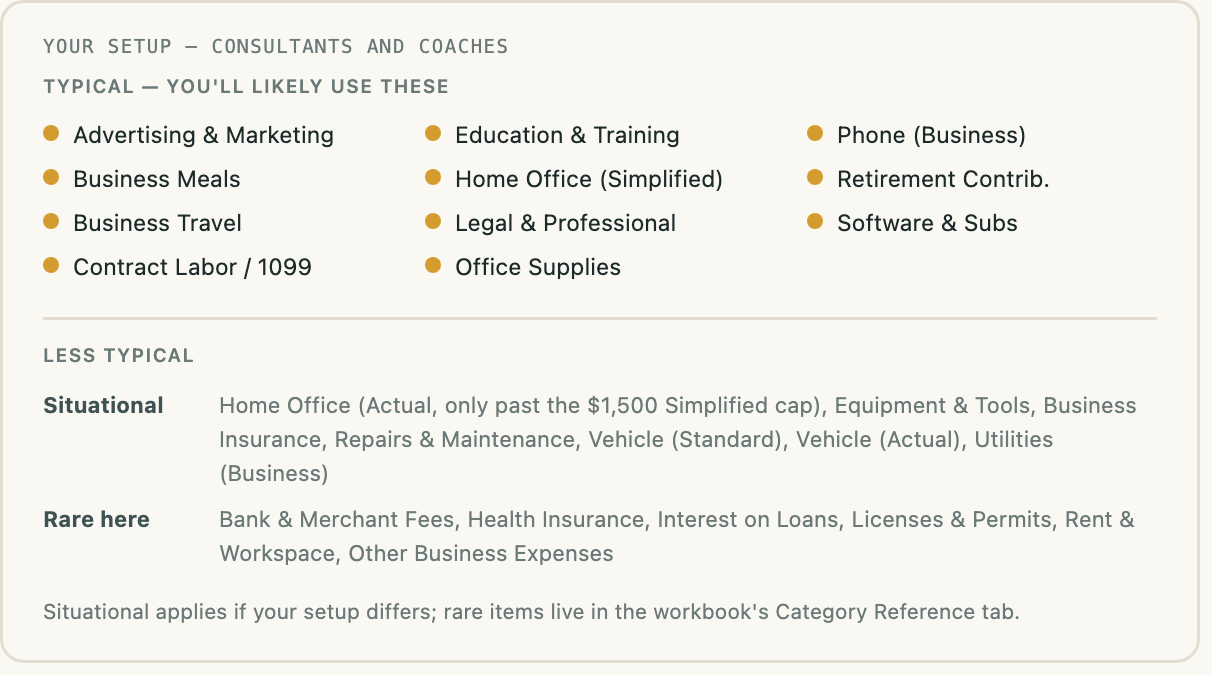
Use these
- Software and Subscriptions (Sch C Line 27b): your CRM (client-relationship management) tool, scheduling tool, video-call platform, course host, and email tool. Usually the single largest recurring category for a consultant or coach.
- Contract Labor / 1099 (Sch C Line 11): a virtual assistant, an editor, a subcontracted coach you bring in on an engagement. Deductible as paid; you'll owe a Form 1099-NEC, short for Nonemployee Compensation (NEC), to any non-corporate contractor you pay $2,000 or more in a year (the threshold for tax years beginning after 2025; it was $600 before).
- Home Office — Simplified (Sch C Line 30): most solo consultants and coaches work from a dedicated home office. The simplified method is $5 per square foot, capped at 300 sq ft ($1,500/year), and requires the space be used regularly and exclusively for business. Worth switching to the Actual-expenses method only if your rent or mortgage, utilities, and insurance, allocated by your office's share of your home's square footage, would clearly exceed that $1,500 cap, which is realistic in a high-cost city with a meaningfully sized office. Actual requires Form 8829, receipts for every allocated expense, and for homeowners, tracking depreciation, which lowers your home's cost basis and can create taxable gain when you sell.
- Business Travel (Sch C Line 24a) and Business Meals (Sch C Line 24b): a discovery call over coffee, a client visit that requires an overnight stay. Meals are 50% deductible when the meal is an ordinary and necessary business expense, isn't lavish, you're present, and it's with a client or other business associate (or you're traveling for business). You don't have to discuss business during the meal; that was the old pre-2018 entertainment test. Travel does not include your regular commute.
- Legal and Professional Fees (Sch C Line 17): contract review, limited liability company (LLC) filing help, your own accountant's fee for business work.
- Advertising and Marketing (Sch C Line 8): your website, paid ads, a copywriter for your sales page.
- Education and Training (Sch C Line 27b): a certification or course, with one boundary that trips people up. See "What Consultants and Coaches Habitually Miss" below.
- Retirement Contributions (Form 1040, not Schedule C): a Simplified Employee Pension (SEP) IRA is the natural fit for irregular retainer/project income. Contributions can flex with what the year actually brings, up to 25% of net self-employment compensation, capped at $72,000 for 2026.
- Phone — Business Portion (Sch C Line 27b): the business-use share of your phone bill, if you use one line for both.
- Office Supplies (Sch C Line 18): the ordinary consumables. Usually a small category for a consulting or coaching practice.
Skip these, unless your practice is a genuine exception
- Vehicle — Standard Rate / Actual Expenses: skip both unless you regularly drive to client sites. A consultant who works over video and occasionally flies to a client does not have a mileage-log business; a coach who runs in-person sessions at multiple locations does.
- Equipment and Tools (under $2,500): skip unless you bought physical gear (a camera and mic for a course, a dedicated laptop). Most consulting work has none. Spent more than $2,500 on a single item? It is still deductible — it just belongs on Schedule C Line 13 (depreciation / section 179) rather than this category, often in full the same year. Ask your CPA.
- Repairs and Maintenance: skip unless you're actually paying to repair business equipment (a laptop, a printer). Uncommon for a consulting or coaching practice, since there's little physical gear to break.
- Utilities — Business Portion: skip if you work from home, regardless of which Home Office method you use. On Simplified, utilities are already baked into the $5/sq ft rate, so claiming them separately double-counts. On Actual, home utilities flow through Form 8829's own calculation, not this line. This category is for a separate, non-home business location (a rented office with its own utility bills); most solo consultants and coaches don't have one.
- Business Insurance: skip unless you carry errors-and-omissions coverage, which some consulting engagements require by contract. If a client's contract requires it, use it; otherwise it's usually not a live category for a consulting or coaching practice.
Alternatives are named here only where the choice changes tax treatment: Home Office Simplified vs. Actual, Vehicle Standard vs. Actual. Everywhere else above, one answer, not a menu.
What consultants and coaches habitually miss
1. The Education and Training boundary. A course or certification that improves skills you already use in your current consulting or coaching practice is deductible. A program that qualifies you to enter a new trade or business is not, even if it feels adjacent. The line is "sharpens what you already do" versus "gets you into something you don't do yet," and it is easy to misjudge from inside your own career. If a course is a genuine boundary case, that's a question for your CPA, not a guess on the sheet.
2. Retirement contributions get skipped because the income is lumpy. Retainer and project income arrives unevenly, so many consultants and coaches never get around to a SEP IRA at all. There's no paycheck deduction forcing the habit. The workbook's Tax Set-Aside tab reserves for quarterly taxes; it does not calculate a retirement contribution for you. Treat "what could I set aside for retirement this quarter" as its own line item you check manually, not something the sheet will remind you of.
A worked month
This example is illustrative, built to match the workbook's structure. It is not a screenshot of the live sample copy, which is still in progress. Once the public sample copy ships, this section will be updated to match it exactly.
A consultant invoices two retainer clients at the start of the month, plus a smaller project invoice mid-month. By month-end, only one has paid.
Income tab
| Client | Invoiced | Status at month-end |
|---|---|---|
| Retainer A | $4,000 | Received |
| Retainer B | $2,500 | Outstanding: aging, days-since-sent ticking up |
| Project invoice | $1,800 | Outstanding: aging, days-since-sent ticking up |
| Total invoiced | $8,300 | $4,000 received · $4,300 outstanding |
Expenses tab
| Item | Amount | Category |
|---|---|---|
| CRM subscription | $60 | Software and Subscriptions |
| Conference travel | $340 | Business Travel |
| Client dinner | $45 | Business Meals (50% deductible) |
| Copywriter invoice | $500 | Contract Labor / 1099 (owe a 1099-NEC if this vendor crosses $600 for the year) |
| Total expenses | $945 |
What the Dashboard shows
| This month | |
|---|---|
| Cash-basis revenue | $4,000 |
| Expenses | $945 |
| Profit | $3,055 |
$8,300 was actually invoiced this month, but only $4,000 has been received. The Dashboard's cash-basis revenue reflects money in hand, not money billed. The $4,300 still outstanding doesn't show up in profit at all; it shows up on the Income tab's aging view, which is exactly what that view is for.
When this guide is not the right fit
This guide is for a US sole proprietor or single-member LLC consultant or coach filing Schedule C, working solo or with occasional subcontractors, under roughly $250K in annual revenue.
It does not cover:
- S-corp consultants. Different entity, different filing complexity. This guide's category mapping does not apply.
- Anyone running payroll. Payroll tax obligations need professional handling this guide does not address.
- Revenue above roughly $250K. CPA oversight of the books, not just a year-end review, is typically warranted at that scale.
- Finance professionals (bookkeepers, accountants, financial advisors offering regulated advice): a different compliance layer applies to your own business that this guide does not cover.
If none of those describe you, the setup above is the one to use.
Where to go from here
Use the categories above inside the Bookkeeping Tracker. This guide interprets the fixed 24-category list; it doesn't add to it. The workbook's own Instructions tab and the full guide cover every tab in detail; this page is the consultant/coach-specific layer on top.
See the Bookkeeping Tracker → · Read the full tab-by-tab guide →
This guide covers the setup for one trade. For the general build that sits underneath it, see the bookkeeping spreadsheet, column by column. Once your books produce a net-profit figure, the tax side follows: why self-employment tax applies to it and what to pay each quarter.
Sources
Internal Revenue Service. Schedule C (Form 1040), Profit or Loss From Business, and Instructions. https://www.irs.gov/forms-pubs/about-schedule-c-form-1040
Internal Revenue Service. Publication 587, Business Use of Your Home. https://www.irs.gov/publications/p587
Internal Revenue Service. Publication 463, Travel, Gift, and Car Expenses. https://www.irs.gov/publications/p463
Internal Revenue Service. About Form 1099-NEC, Nonemployee Compensation. https://www.irs.gov/forms-pubs/about-form-1099-nec
Internal Revenue Service. Publication 560, Retirement Plans for Small Business. https://www.irs.gov/publications/p560