

Knowledge
Why Do I Owe Self-Employment Tax If I Barely Made Money?
"Nobody told you… another type of tax, which is completely separate."
We read through more than a thousand posts from self-employed people talking about tax, across Reddit, YouTube and X, to find out what actually catches them out. That sentence sits on top of the loudest theme in the whole set. The complaint is almost never that tax is hard. It is that a second, separate tax existed at all, and nobody mentioned it until the bill arrived.
If that landed with recognition: your return is almost certainly correct.
The bill is real. Nothing was filed wrong. The surprise isn't yours. It's structural.
And if your net profit for the year was under $400, you owe no self-employment tax at all. That is a complete statutory exit, not a technicality, and the details are below. Everyone else: the bill follows three numbers, and once you know them it stops being an ambush.
This is not a mistake, and not a penalty for being small
Self-employment tax is a second, legally imposed federal tax, structurally separate from the income tax you already understand. It is not a filing error, and it is not something the Internal Revenue Service (IRS) applies to punish small earners.
Federal law imposes it under Internal Revenue Code §1401, which sits in Chapter 2 of Title 26, a different chapter from the one governing income tax. That separation is statutory, not a policy quirk a different filing choice could undo. It is also the reason the two taxes behave differently when you start deducting expenses, which catches most people out.
A single-member limited liability company (LLC) taxed as a disregarded entity owes this tax on exactly the same basis as a sole proprietor. Entity type does not change the obligation.
Scope: United States sole proprietors and single-member LLCs taxed as disregarded entities. S-corp elections and entity structuring are outside this article.
This is the federal picture only
Everything below is federal. Self-employment tax funds Social Security and Medicare, it is imposed by federal law, and it is calculated on Schedule SE with your federal return.
Your state, and sometimes your city, is a separate question with separate rules. Most states levy their own income tax, which reaches your business profit on its own terms (look up your state's rates). Some jurisdictions go further and tax self-employment income directly. Oregon, for example, charges transit self-employment taxes for the TriMet and Lane Transit districts, with their own returns and their own $400 threshold. New York City taxes unincorporated business income through a separate city tax.
There is no single national answer to "what do I owe my state," because every state approaches it differently and some localities add their own layer. Treat the federal number below as one line of your total bill, not the whole of it, and check your own state and city before you budget.
The same tax your employer was paying in secret
Self-employment tax is Social Security and Medicare, the identical programs funded by every W-2 paycheck. The combined rate is 15.3%: 12.4% for Social Security and 2.9% for Medicare, per the IRS self-employment tax guidance.
Here is why you never saw it.
On a $1,000 W-2 paycheck, $76.50 is withheld from your side: 6.2% for Social Security and 1.45% for Medicare. Your employer then sends another $76.50 at those same rates, matching you dollar for dollar (IRS Topic No. 751). The full contribution is $153 on $1,000, or 15.3%, but only half ever appeared on your pay stub.
As a sole proprietor, both halves land on your return. Nothing was added. The half that was always being paid on your behalf simply became visible, and became yours.
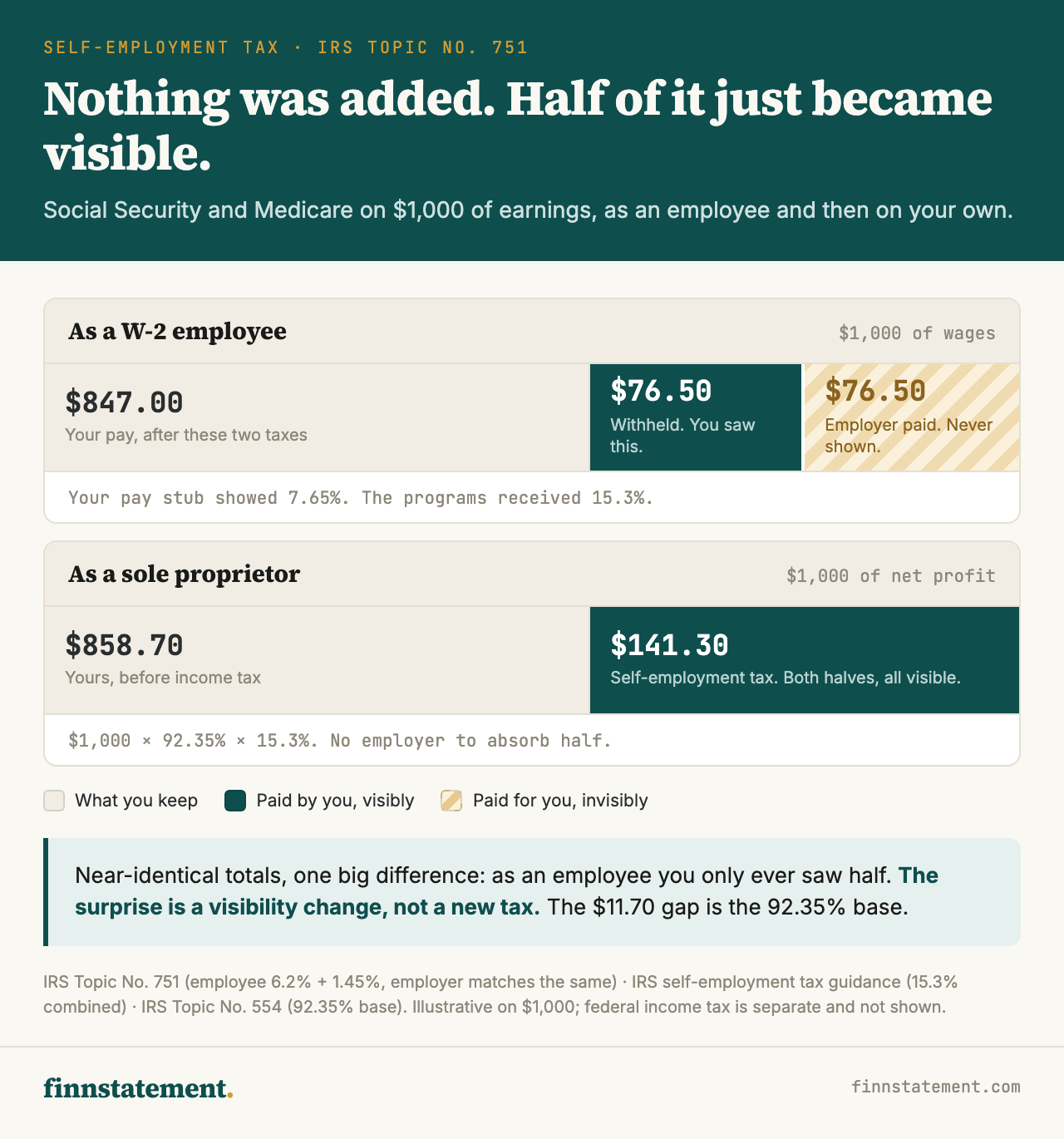
The totals land in nearly the same place. On $1,000, an employee's two contributions total $153 while a sole proprietor owes $141.30. The $11.70 difference is the 92.35% base, which stands in for the deduction an employer takes on its own half. The real change isn't the amount. It's that you can finally see all of it.
The type of work doesn't change this. Consulting, selling goods, gig platform payments: same mechanism for any United States sole proprietor filing Schedule C.
Writing everything off won't make this one go away
Deductions reduce self-employment tax, but only proportionally, and that distinction is where most of the money gets lost.
Under Internal Revenue Code §1402(a), net earnings from self-employment are gross business income minus the deductions attributable to that business. Lower net profit means a smaller base, and a smaller base lowers both taxes in step.
Every number here starts from net profit, which is why the records matter: if yours don't yet produce that figure reliably, build the bookkeeping spreadsheet first.
Concretely: $10,000 of net profit produces roughly $1,413 in self-employment tax. Deduct $2,000 in legitimate business expenses and profit falls to $8,000, so the tax drops to roughly $1,130. That reduction is real.
And the $8,000 you kept is still fully subject to the 15.3%. The deduction shrank the bill; it did not shelter what remains. There is no write-off that exempts profit you keep.
The employer-equivalent deduction, the half of self-employment tax you're allowed to deduct, doesn't change this either. The IRS states its scope precisely:
"You can deduct the employer-equivalent portion of your self-employment tax in figuring your adjusted gross income. This deduction only affects your income tax. It does not affect either your net earnings from self-employment or your self-employment tax."
That deduction is authorized by Internal Revenue Code §164(f). It lowers your income tax. Your self-employment tax is untouched.
This is the part worth carrying: deductions lower one of your two taxes fully, and the other only in proportion. A product that promises to make your tax bill vanish through aggressive write-offs is selling against arithmetic.
The three numbers that make this predictable
Everything above resolves into three figures you can apply yourself.
$400, the floor. Under Internal Revenue Code §1402(b)(2), net earnings below $400 are excluded from self-employment income entirely. Below it, you owe nothing, confirmed by IRS Topic No. 554 and Publication 334. A complete exit.
92.35%, the base. The rate is not applied to your whole profit. Per Topic No. 554, "generally, the amount subject to self-employment tax is 92.35% of your net earnings." This approximates the deduction an employer would take on its side of payroll. You don't calculate it; it flows through Schedule SE automatically.
15.3%, the rate. 12.4% Social Security plus 2.9% Medicare, applied to that base.
Worked example: $5,000 of net profit
| Step | Calculation | Result |
|---|---|---|
| 1. Apply the base | $5,000 × 92.35% | $4,617.50 |
| 2. Apply the rate | $4,617.50 × 15.3% | $706.48 |
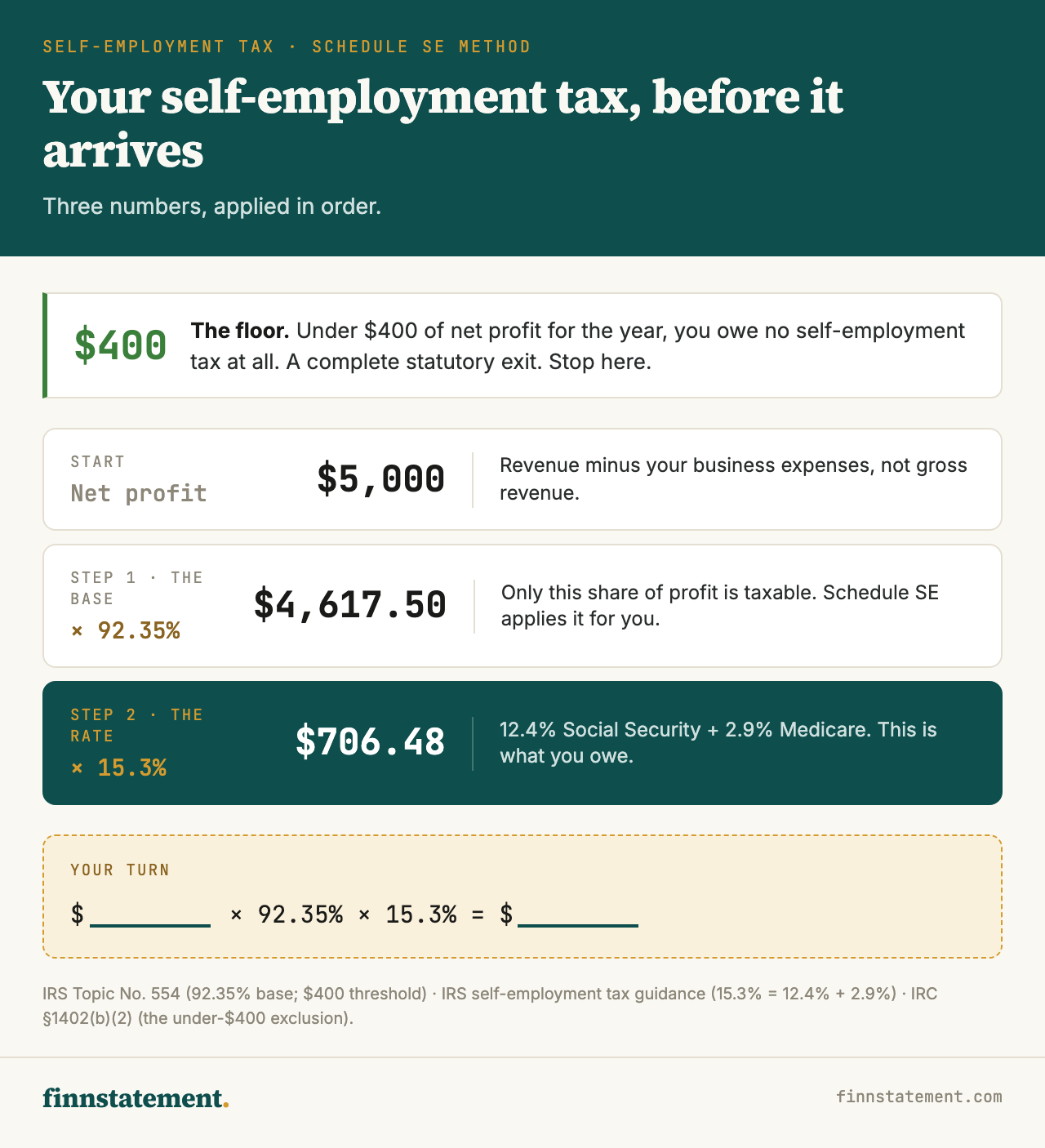
Substitute your own net profit in step one. That is your exposure, and you can run it any month of the year rather than discovering it in April.
Two boundaries worth stating plainly. If you have W-2 wages alongside freelance income, self-employment tax applies only to the freelance net earnings, because the streams are computed separately. And the 12.4% Social Security portion stops at an annual wage ceiling while the 2.9% Medicare portion never does; that ceiling changes yearly and is far above the income level this article addresses.
These three constants are maintained, with sources, at finnstatement.com/products/tracker#se-tax-facts.
What happens if you ignore it or guess wrong
This is not a one-time event. Every year net profit clears $400, the obligation restarts: same rate, same form, same arithmetic.
Underpayment compounds it. When self-employment tax goes unpaid or badly underestimated during the year, underpayment penalties stack on top of the tax itself. The bill does not shrink because the year was hard.
The IRS pay-as-you-go system exists for exactly this: Form 1040-ES covers income tax and self-employment tax together, in quarterly installments.
What to do with this number now
You have an exposure figure. The remaining job is making sure it never arrives as a year-end lump sum.
The mechanics of that, including the safe-harbor rule, the four due dates, and how much of each payment to set aside, are covered in Self-Employed Taxes: The Actual Math, the Actual Dates, and the Safe-Harbor Rule. That is the natural next read.
Today: take the number you calculated above, open that article, and run the safe-harbor rule against your year-to-date income. That single pass converts this from a bill you dread into a figure you already knew.
If you want a running start on the deductions side, our free Deduction Cheat Sheet is a one-page reference for what actually counts, tied to real IRS sources.
Sources
Every figure and rule above is drawn from IRS and primary statutory sources, each fetched and verified 2026-08-11:
- Self-employment tax rate of 15.3% (12.4% Social Security + 2.9% Medicare), the $400 filing threshold, and the employer-equivalent deduction. IRS, Self-Employment Tax (Social Security and Medicare Taxes)
- The 92.35% net-earnings base, and the $400 threshold confirmed. IRS, Topic No. 554, Self-Employment Tax
- The W-2 split: employee pays 6.2% + 1.45%, employer matches the same. IRS, Topic No. 751, Social Security and Medicare Withholding Rates
- Statutory basis for the tax, and its placement in Chapter 2 of Title 26, separate from the income tax. 26 U.S. Code §1401
- Net earnings from self-employment defined as business income minus attributable deductions. 26 U.S. Code §1402(a)
- The under-$400 exclusion from self-employment income. 26 U.S. Code §1402(b)(2) · IRS Publication 334
- The deduction for one-half of self-employment tax, and its limit to income tax only. 26 U.S. Code §164(f)
- Where the tax is calculated. IRS, Instructions for Schedule SE
- Estimated tax as the pay-as-you-go vehicle covering income tax and self-employment tax together. IRS, About Form 1040-ES
- State and local treatment varies, and some jurisdictions tax self-employment income directly. Oregon Department of Revenue, Transit Self-Employment Taxes