

Knowledge
Self-Employed Taxes: The Actual Math, the Actual Dates, and the Safe-Harbor Rule
"I just became self-employed, and I have no clue how much I'm supposed to take out for taxes, or how often I'm supposed to pay them." That is the kind of question people ask constantly when they first start working for themselves. Nobody hands new solopreneurs a manual. This is the manual: the actual IRS mechanics, not a guess, not a vibe.
The tax nobody mentioned: what you're paying, in brief
Most people picture one federal tax: income tax, charged by bracket, filed in April. Self-employed people owe a second, separate one on top of it. Self-employment (SE) tax is a flat 15.3% funding Social Security and Medicare. A W-2 employee pays into those same programs every paycheck, with their employer quietly covering half; on your own, both halves are yours.
Three numbers drive it: the 15.3% rate, the 92.35% of net profit it applies to, and the $400 of net profit that triggers it. Deductions lower the profit and so lower the tax, but nothing shelters profit you keep.
That is all you need to use the dates and the safe-harbor rule below. If the bill itself is what brought you here, start with Why Do I Owe Self-Employment Tax If I Barely Made Money? instead. It covers why the tax exists, why your W-2 job never showed it to you, and why "writing everything off" doesn't make it disappear. Then come back here for the mechanics.
Two boundaries this article keeps. First, everything here is federal: the dates, the safe-harbor rule, and the 15.3% all refer to your federal return. Your state, and sometimes your city, is a separate bill with separate rules (look up your state's income tax rates), and a few jurisdictions tax self-employment income directly rather than only through income tax. Oregon, for instance, charges transit self-employment taxes for the TriMet and Lane Transit districts, on their own returns. Check your own state and city; the federal number is one line of the bill, not all of it.
Second, the 12.4% Social Security portion applies only up to the annual wage base ($184,500 for 2026), while the 2.9% Medicare portion has no cap.
Everything below assumes you know your net profit. If your records don't yet produce that number reliably, start with the bookkeeping spreadsheet build and come back.
The four dates: quarterly estimated tax and Form 1040-ES
First-year filers say a version of this every spring: they know they are supposed to pay quarterly, but not how much, and the talk of penalties makes it scarier. It is the second-most-common source of dread for the newly self-employed: paying tax on money already earned and spent, four times a year, before the year is even over.
Why prepayment exists at all: the U.S. tax system is pay-as-you-go. A W-2 employee's tax gets withheld from every paycheck automatically. A self-employed person has no withholding, so the IRS requires the equivalent: estimated tax payments, submitted using Form 1040-ES on a quarterly schedule, generally covering both income tax and SE tax on self-employment earnings. These are your federal payments (income tax and SE tax bundled together); if your state has its own income tax, it runs a separate estimated-tax schedule, often on the same four dates.
The four 2026 due dates (2026 tax year, per the 2026 Form 1040-ES instructions):
- Q1: April 15, 2026
- Q2: June 15, 2026
- Q3: September 15, 2026
- Q4: January 15, 2027
Note that these aren't evenly spaced calendar quarters (Q2's window is only two months, Q3's is three). That's a feature of how the IRS defines the payment periods, not an error.
Sources: 2026 Form 1040-ES and Instructions; IRS Publication 505 (Tax Withholding and Estimated Tax). Full links in Sources below.
The rule that removes the guesswork: safe harbor
Almost nobody in the research had heard of this rule. Once they do, it changes everything: you are not required to correctly forecast this year's income to avoid a penalty. The IRS gives you an alternative that's based entirely on numbers you already know.
The IRS rule (IRC §6654): the required annual payment to avoid an underpayment penalty is the smaller of two numbers:
- 90% of your current year's total tax, or
- Your "safe harbor" amount, based on your prior year's tax: 100% of last year's total tax, or 110% of last year's total tax if your prior-year adjusted gross income was over $150,000 (over $75,000 if married filing separately).
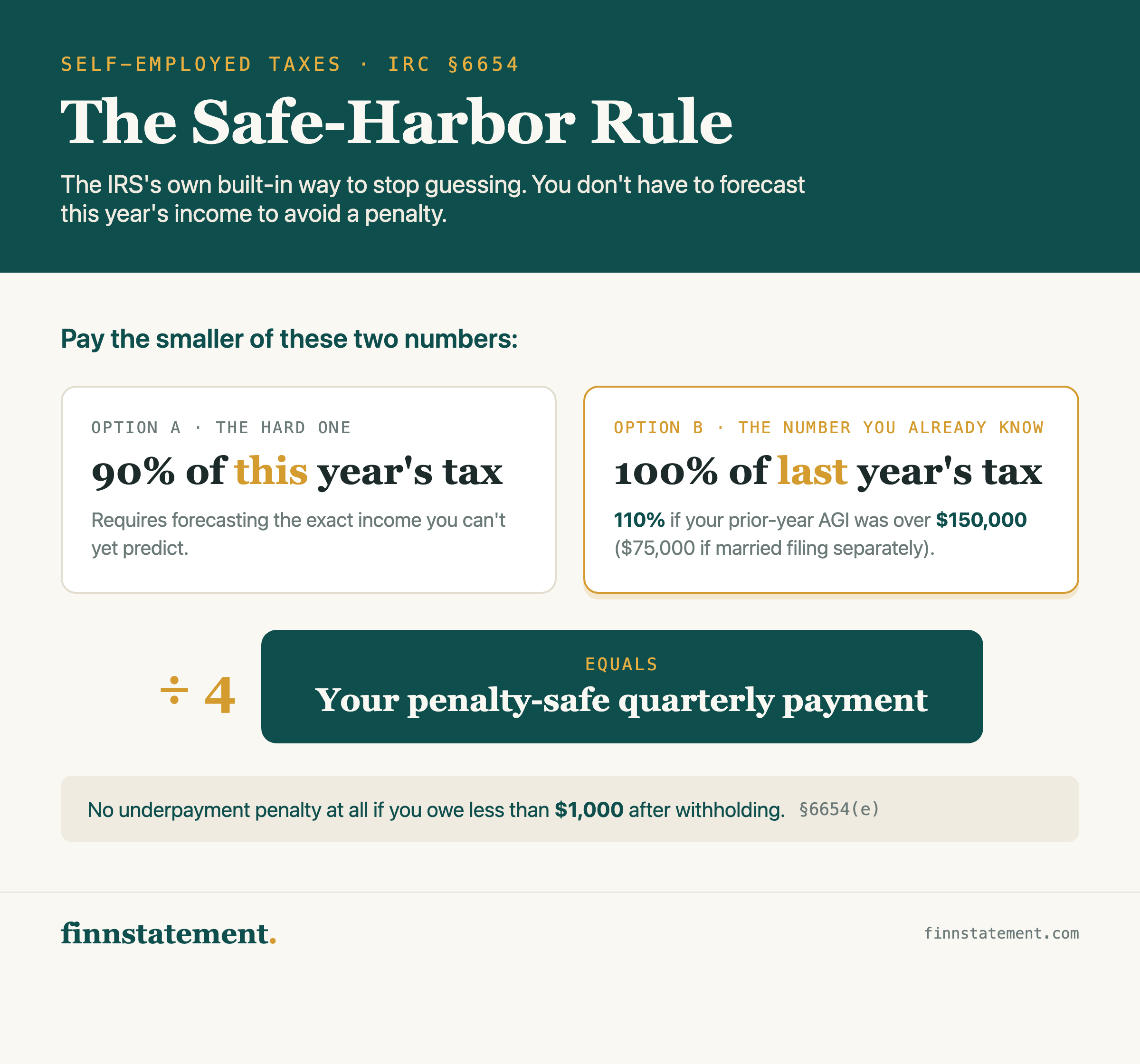
That safe-harbor amount, divided by four, is a penalty-safe number you can pay each quarter without knowing anything about how this year turns out. If you pay it on time, in each of the four required installments, the IRS will not assess an underpayment penalty, whether this year's income is higher, lower, or wildly unpredictable. Avoiding the penalty is not the same as being paid up: you may still owe tax when you file. This is why the research calls it "the missing key": the fear is "guess wrong… penalty for the privilege," and the safe harbor rule is the IRS's own built-in way to stop guessing.
Conditions worth knowing:
- Your prior-year return has to have covered a full 12 months for the safe harbor to apply.
- No underpayment penalty applies at all if the tax on your return, minus your withholding, is under $1,000 (IRC §6654(e)(1)). Only withholding counts toward this test, not refundable credits. That floor exempts very small liabilities entirely.
- Farmers and fishers use a different rule (a 66⅔% safe harbor and a single annual installment), not covered here; see Form 1040-ES if that applies to you.
One honest caveat: the safe harbor is a floor that protects you from a penalty. It is not automatically "the minimum you'll ever owe." If your current-year tax turns out to be lower than your prior-year-based safe harbor number, the 90%-of-current-year option (item 1 above) could in theory be smaller. Most people never calculate that side, because it requires forecasting the exact thing safe harbor lets you skip. That's why "the safe harbor is the required amount" is a simplification, not the precise rule.
Sources: IRC §6654; 2026 Form 1040-ES; IRS Publication 505. Full links in Sources below.
How much to actually set aside
Two different questions get conflated constantly, and separating them is most of the relief:
Question 1: "What keeps me legally penalty-safe?" Answer: the safe-harbor number above (IRC §6654): 100% or 110% of last year's total tax, divided by four. This is the IRS-grounded anchor. It doesn't tell you what you'll ultimately owe; it tells you what protects you from a penalty in the meantime.
Question 2: "What should I physically move into a separate account so I'm not caught short?" This is a cash-flow habit, not a legal requirement, and the honest answer is: it depends on your income, deductions, state taxes, and filing status. The widely-used rule of thumb in the self-employed community, set aside 25–30% of what you earn, is exactly that: a practitioner rule of thumb, not an IRS rule. There is no IRS publication that says "set aside 30%." It's a rough proxy that bakes in SE tax plus an estimate of federal (and sometimes state) income tax, and it works reasonably well for many solo service businesses precisely because it's built with margin for error.
One wrinkle that changes the number. Your Schedule C business expenses cut both taxes, because they lower the net profit both are calculated from. But a few common deductions cut only your income tax: self-employed health insurance and retirement contributions (SEP-IRA, Solo 401k) are subtracted after net profit is set, on a later part of the return, so they shrink your federal income tax without changing the self-employment-tax base. If you are sizing a set-aside around those, size it against SE tax at the full rate.
Used together: the 25–30% habit keeps cash physically available; the safe-harbor number tells you the minimum you actually need to send the IRS each quarter to stay penalty-safe. A number without a source is a guess. A number tied to IRC §6654 is a rule you can verify yourself.
Self-Employment Tax Estimator
An AI prompt that interviews you and estimates your quarterly self-employment tax. Works whether or not you filed as self-employed last year.
You are a careful tax-education assistant. Help a self-employed person in the United States estimate their federal **self-employment tax** for the year (the 15.3% Social Security and Medicare tax) and what to set aside for it each quarter. Be clear throughout: this estimates **self-employment tax only**. It is not an income tax estimate; federal income tax is separate and is owed on top of this. You produce an educational estimate the person will verify with a CPA or at IRS.gov, not tax advice.

First, ask which situation applies: "Is this your first year earning self-employment income, or did you also have self-employment income last year?"

If they had self-employment income last year, anchor on their prior return:
1. "On last year's Schedule C, what was your net profit (line 31, business income minus business expenses)? If you're not sure, give me your total business income and total business expenses and I'll work it out."
2. "Do you expect this year to be similar, higher, or lower? Give me your best estimate of this year's net profit, and I'll start from last year and adjust."

If it's their first year, build from expectations:
1. "About how much do you expect to earn from your self-employment this year, before expenses?"
2. "About how much will you spend on deductible business expenses this year (software, mileage, supplies, and the like)? These lower the tax, so a rough total is fine."
Their estimated net profit is expected income minus expected expenses.

Then calculate, showing your work:
- Net earnings subject to SE tax = net profit x 92.35%.
- If net earnings are $400 or less: no self-employment tax is owed for the year. Stop and tell them.
- Otherwise: Social Security part = 12.4% of net earnings, counting only the first $184,500 (the 2026 wage base). Medicare part = 2.9% of all net earnings. Self-employment tax = Social Security part + Medicare part. (For most solopreneurs under $184,500 in net earnings, this works out to a flat 15.3% of net earnings.)
- Quarterly set-aside for self-employment tax = self-employment tax / 4.

Present it plainly: the estimated annual self-employment tax, the quarterly amount to set aside, and the 2026 federal due dates (April 15, 2026; June 15, 2026; September 15, 2026; January 15, 2027).

Then include these points briefly:
- This covers self-employment tax only. Federal income tax is separate and additional, so set aside for both.
- Deductible business expenses lower this tax because they lower your net profit, so track them all year.
- These are federal payments; if your state has income tax, it runs a separate estimated-tax schedule.
- For a single penalty-safe number that covers all your federal tax at once, ask about the "safe-harbor" method (100 to 110% of last year's total tax); the article explains it.
- Very high earners have extra rules (an additional Medicare tax). If net profit is well into six figures, confirm with a CPA.

Keep a plain, calm, non-hype tone. Do not request any identifying information beyond the numbers needed for the estimate.

End every response with this exact disclaimer on its own line:

> This is an estimate to help you think about self-employment tax. It is not tax advice and not a tax filing. Your specific situation can change these numbers, so always consult a licensed CPA about your circumstances and verify current figures at IRS.gov.
Works best in: Claude (Sonnet or Opus), ChatGPT (GPT-5)
Open the full prompt page →Want a running start without doing the math by hand? Our free Deduction Cheat Sheet is a one-page reference for what counts, tied to real IRS sources.
Sources
Every figure and rule above is drawn from IRS and SSA primary sources (verified 2026-07-18):
- Self-employment tax: 15.3% (12.4% Social Security + 2.9% Medicare), the 92.35% net-earnings base, and no Medicare wage cap. IRS, Self-Employment Tax (Social Security and Medicare Taxes) · IRS Topic No. 554, Self-Employment Tax
- 2026 Social Security wage base ($184,500). Social Security Administration, Contribution and Benefit Base
- $400 net-earnings SE filing threshold. IRS Instructions for Schedule SE · IRS Publication 334
- Quarterly estimated-tax due dates and Form 1040-ES. IRS Form 1040-ES, Estimated Tax for Individuals
- Safe harbor and the $1,000 no-penalty floor (IRC §6654 and §6654(e)). 26 U.S. Code §6654
- Statutory basis for the self-employment tax (IRC §1401). 26 U.S. Code §1401